

Subcision is a procedure commonly used to treat atrophic acne scars. What does this procedure involve, and how effective is it for scar treatment? Find out more in this article.
Quick answer: Subcision is a scar-base release technique that helps detach fibrous scar bands and supports the elevation of depressed skin in the treatment of atrophic acne scars.
How subcision works
Beneath an atrophic scar, fibrous tissue bands act as anchors, tethering the dermis downward and creating a visible depression on the skin’s surface. Subcision (scar-base release) addresses this by disrupting the fibrous bands with a needle or cannula, releasing the scar base and allowing the depressed skin to elevate. The needle or cannula is inserted horizontally beneath the skin to release the fibrous bands.
Subcision is often considered an important foundational step in the treatment of atrophic acne scars, particularly long-standing scars, because it directly targets the underlying cause—the tethering scar bands. Once these bands are released, subsequent collagen-stimulating treatments can work more effectively.
Subcision techniques
With a relatively long history of development, dating back to 1995, subcision has undergone various modifications and refinements. Each technique is suited to specific indications.
Scar-base release with a medical needle
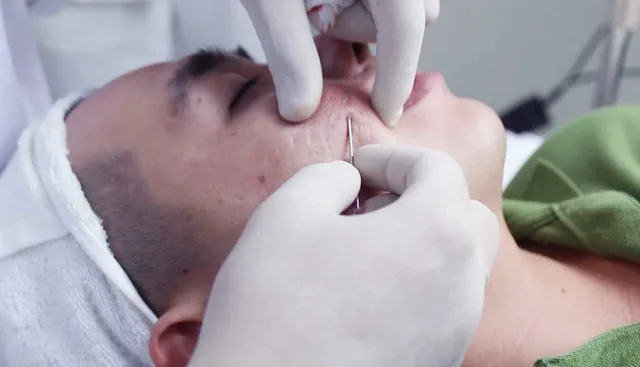
The doctor uses a specialized sharp-tipped medical needle, typically a Nokor needle or a large-gauge needle, inserted beneath the skin at an angle to release the fibrous scar bands. This technique is suitable for deep atrophic scars with prominent fibrous tethering. However, due to the relatively large needle tip, it may cause more bruising and swelling in the surrounding skin.
Scar-base release with a cannula

Compared with the traditional technique using a medical needle, the use of a cannula (a flexible tube with a blunt tip) helps minimize tissue trauma and allows for more flexible and gentle manipulation. This technique is suitable for extensive rolling scars and deep scars.
Scar-base release with CO2 gas
Medical-grade CO2 gas is delivered under high pressure to generate sufficient force to separate the fibrous tissue beneath the skin. As this technique does not involve a needle, it is less invasive than the two techniques described above. CO2 scar-base release is suitable for scars with soft fibrous tissue and recently formed scars. However, because it is less invasive, it may be less effective for long-standing scars, scars with dense fibrous tissue, or deep scars.
Who should and should not undergo subcision
The effectiveness and safety of subcision depend largely on the expertise of the practitioner. Before recommending a treatment, the doctor will assess your skin to determine which methods are appropriate for you.
Candidates for subcision
Scar-base release may be suitable for people who:
- Have rolling scars or deep boxcar scars.
- Do not currently have a skin infection, underlying medical conditions, or use medications that may affect wound healing.
- Want to accelerate scar-filling results.
Contraindications to subcision
People with any of the following conditions should not undergo subcision for atrophic acne scars:
- Have ice pick scars with narrow, deep, sharply pointed bases and no significant fibrous tethering.
- Have a history of keloids or abnormal scar overgrowth.
- Have an active skin infection.
- Have a bleeding disorder or are taking anticoagulants.
- Are taking oral retinoids or have discontinued them within 12 months before subcision.
For the most accurate assessment, doctors will perform an examination and evaluate each case individually.
Effectiveness of subcision in the treatment of atrophic acne scars
The scientific basis and clinical effectiveness of subcision have been demonstrated over many years. Due to its effectiveness, scar-base release is commonly incorporated into atrophic acne scar treatment protocols and may serve as an important initial step.
A study in the United States by Murad Alam and colleagues involving 40 patients with acne scars found that 90% of participants reported noticeable improvement, with an average reduction in scar depth of 50–60% after 6 months.
A 2019 study by Shashank Bhargava involving 45 patients with atrophic acne scars who underwent four sessions combining subcision and microneedling found that 95.6% of participants experienced improvement, with 17.8% achieving 75–100% improvement three months after the final treatment session.
Therefore, the clinical value of subcision is well established. However, the extent of improvement also depends on the practitioner’s expertise and the accompanying treatment modalities. These may include topical treatments, mesotherapy, laser therapy, microneedling, and others.
Conclusion
Scar-base release (subcision) is a well-established treatment for atrophic acne scars and is indicated in selected cases. To ensure safety, patients should visit a dermatology clinic or hospital for professional assessment, an individualized treatment plan, treatment by a qualified practitioner, and appropriate follow-up care.
Follow the Knowledge section for more useful information!
Related articles:


