Blackhead Treatment in Ho Chi Minh City: Clearing Open Comedones Safely
Blackheads don't clear on their own — the oxidized plug has to come out. Doctor-led blackhead treatment in HCMC: extraction, medical peels, IPL. Free exam.
Medically reviewed by Dr Quynh Trang, Dermatologist (HCMC) · Updated August 1, 2026
## Do blackheads go away on their own?
Almost never — and waiting is the part that costs you. A blackhead is an open comedone: a plug of sebum and keratin wedged in the neck of the follicle, with the pore still open so the exposed tip oxidizes and darkens. Your skin has no mechanism for pushing that plug out, so what actually clears it is removal — extraction through a softened, dilated pore, with medical peels to loosen the keratin that traps the next one. At WeDo Skin Clinic (District 1 and District 2, HCMC), a board-certified dermatologist examines your skin under multi-layer analysis free of charge, then builds the plan: extraction with barrier recovery from 760,000 VND per session, medical peels 790,000–1,500,000 VND per session, IPL for oil and bacterial control 370,000 VND per session.
Most people wait because blackheads feel minor. They don’t hurt, they don’t swell, and they read as a cosmetic nuisance rather than a condition. But mild symptoms are not the same as temporary. The plug inside the follicle has been compacted over weeks and adheres to the follicular wall — your skin sheds the surface layer daily, but nothing inside the follicle is part of that cycle.
The second reason blackheads persist is mechanical. A plug sitting in a follicle holds the opening dilated, like a wedge. The longer it stays, the more the elastic tissue around that opening loses its ability to spring back — which is why a comedone extracted after many months often leaves a pore that reads larger than it did before. That, not the color, is the argument for treating early. For a broader look at how non-inflamed lesions form and behave, see what causes non-inflammatory acne; for the full range of acne protocols we run, start from medical acne treatment at WeDo.
## Why are blackheads black? The open-comedone mechanism
Four steps, and knowing them explains why almost every home method misses.
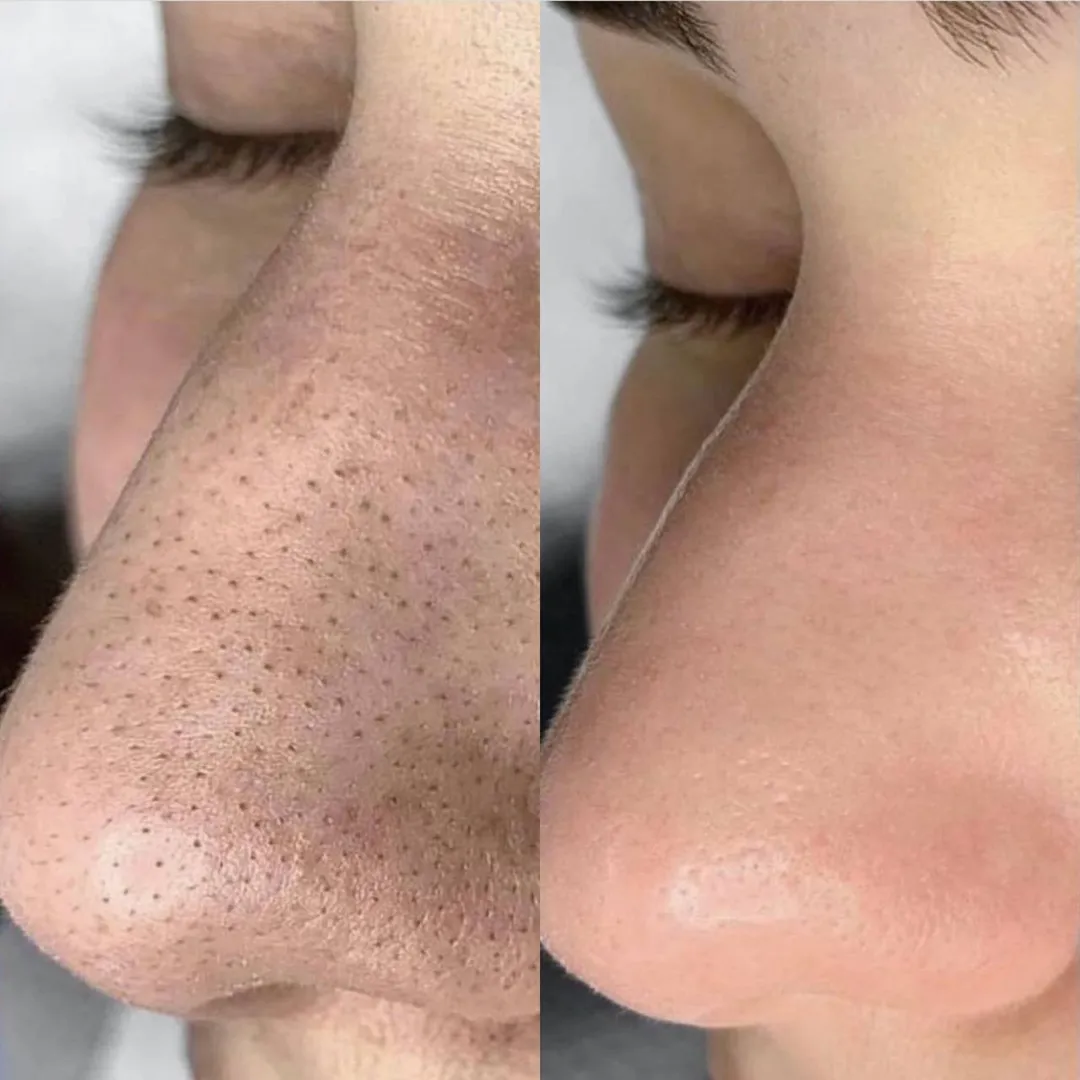
First, the follicular neck becomes hyperkeratinized: keratinocytes shed faster than normal and stick together instead of falling away. Second, the sebaceous gland keeps producing at its usual rate while the exit route narrows, so sebum accumulates behind the obstruction. Third, keratin and sebum compact into a dense plug — but unlike a closed comedone, the pore here stays open. Fourth, because the pore is open, the exposed head of the plug meets air: melanin in the keratin and lipids in the sebum oxidize, and that surface darkens from brown to black.
So the color is not dirt. This is the most expensive misconception in the category, because it leads straight to the wrong behavior — washing more often, scrubbing with grit, running a cleansing brush every night. None of that reaches a plug sitting inside the follicle, and all of it erodes the barrier at the surface. Skin gets tight and dehydrated, sebum production compensates upward, and you have created the conditions for the next crop. A related myth worth clearing up separately: whether a blackhead can turn into a mole.
### How open comedones differ from closed ones
An open comedone has an exit, so the head of the plug is exposed and oxidizes; a closed comedone is sealed under keratin, keeps its skin color, and is felt rather than seen — that lesion type is covered on our hidden acne treatment page, since it needs a different approach.
### Blackheads on the nose: why the T-zone gets the most
Three local factors stack up. Sebaceous gland density is highest on the nose, alar creases and forehead, so more sebum drains into each follicle there than on the cheeks. The stratum corneum is also thicker across that zone, which makes the follicular neck easier to block. And it is the area with the most contact with foundation and heavier-textured sunscreen — products that settle into the alar creases when evening cleansing is done in a hurry.
Worth saying plainly: not every dot on your nose is a comedone. Sebaceous filaments are evenly distributed, tiny, light gray, and a normal part of follicular anatomy; blackheads sit unevenly, protrude, and have a distinctly dark head. Squeezing a sebaceous filament doesn’t remove it, because it was never a plug to begin with.
## Why squeezing and pore strips make pores look bigger
The real question is not whether open comedones can be extracted — they can, and they are the lesion type most suited to extraction. The question is with what force, at what moment, with what instrument. Those three variables decide whether the area looks smoother afterward or worse. If you are wondering where the line sits generally, we cover when acne should and shouldn’t be extracted separately.
### Squeezing with fingers or a non-sterile tool
Two fingertips press inward from the sides, generating lateral force, while the plug sits along the axis of the follicle. The result splits almost every time: the head lifts out and you feel successful, and the body of the plug is driven deeper than where it started. If the pressure is high enough, a follicular wall already thinned by months of wedging can tear, releasing sebum and bacteria into surrounding tissue — a reliable way to turn a non-inflamed open comedone into a red, tender papule.
The second problem is sterility. Fingernails, an unsterilized extraction tool and a bathroom counter all introduce bacteria into a pore that is open and has just been traumatized. That is why a spot that was “only a dark dot” last night is a sore red bump by morning.
### Do pore strips actually remove blackheads?
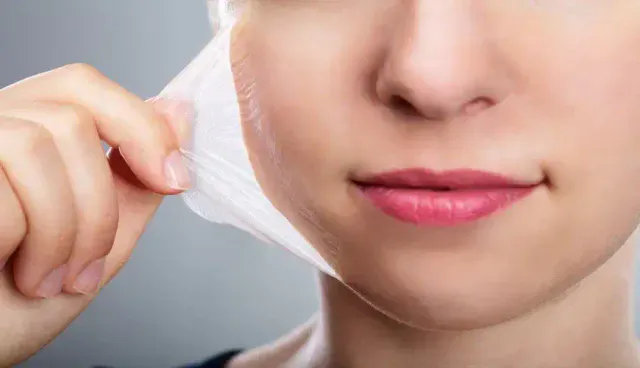
A pore strip works by vertical traction: adhesive grips the hardened head protruding from the pore and pulls it upward. Something genuinely comes out — but it is the tip of the plug, not the plug. The body remains in the follicle, its newly exposed surface oxidizes, and the nose is clear for a few days before it looks exactly as it did before. That is the loop people describe as clean for one evening, then back to normal.
The cost sits in the fact that traction cannot distinguish a comedone from healthy stratum corneum. Repeated stripping takes the protective layer with it: dry, red skin that stings under products you have used for years, followed by compensatory oil. A pore held under repeated traction also loses elasticity, and that is the practical route from “blackheads on my nose” to “large pores on my nose.” Our detailed breakdown sits on blackhead removal on the nose.
### When a blackhead turns into inflamed acne
Once the plug is driven deeper and the follicular wall is damaged, the sealed low-oxygen space beneath becomes favorable for resident skin bacteria to multiply, and the lesion becomes a red, tender papule. From that point the priority is no longer extraction but calming the inflammation, which is what inflammatory acne treatment addresses; if the inflammation goes deeper and consolidates into firm nodules, that is cystic acne with its own protocol.
So what does correct extraction change? The order of operations. The keratin sealing the follicular neck is softened and the pore dilated first, and only then is the plug brought out along the follicular axis with sterile instruments — and only the plugs that are ready. That procedure is medical acne extraction. The softening step is usually done with a medical peel, because BHA (salicylic acid) is oil-soluble and can penetrate the sebum plug itself rather than acting only on the surface.
Depending on your skin, your dermatologist may add IPL where skin is oily and inflames easily or still carries post-acne marks, and hydration electrophoresis to deliver soothing actives into the superficial layer straight after extraction. Every device behind these steps is listed in our treatment technology overview. Individual prices are in the table below, the complete list of every service we offer is on the WeDo price list, and how these line items combine into a full acne course is set out separately on acne treatment cost. The sequence of exam, treatment and review is the same across all our services and is described in WeDo’s treatment journey.
Visiting or living in HCMC short-term? Our dermatologists consult in English, and both clinics — District 1 and District 2 — run the same protocols. An extraction session with a light peel leaves no crusting and no visible downtime, so it fits comfortably a day or two before a flight; heavier peels are planned differently and we will say so at the exam. The first consultation and skin analysis cost nothing, so it is a reasonable first stop even if you only want to know whether those dots are comedones or sebaceous filaments — book a free consultation.
How it works
Medical acne extraction
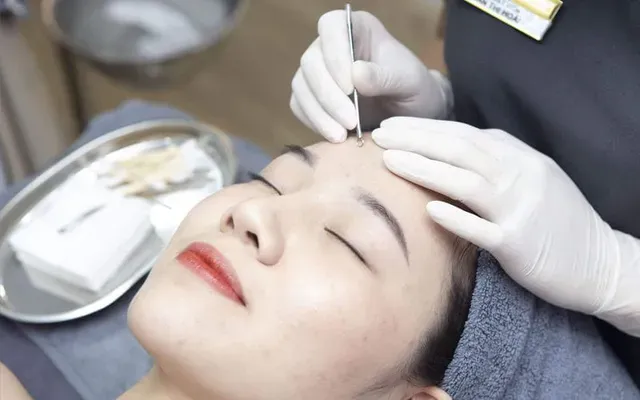
Before any instrument touches the skin, the keratin sealing the follicular neck is softened and the pore is dilated, so the plug has an existing exit rather than being forced through a narrow opening. It is then brought out along the axis of the follicle with sterile instruments — force travels lengthwise, never laterally — so the body of the plug is not pushed back down. The governing rule is that only plugs that are ready come out; anything still firmly adherent is left for the next session rather than chased with more pressure. Indicated for open comedones on the nose, alar creases, forehead and chin. It is normally paired with a recovery step in the same visit, and the number of sessions depends on how densely the comedones sit — your dermatologist reassesses after each one. The treated area may look slightly flushed for a few hours; you go back to your normal day immediately. Oily and acne-prone skin program with recovery, 760,000 VND per session; the combo version with an added brightening step, 910,000 VND per session.
Medical peel
A peel uses acid at a strength your dermatologist selects to loosen the bonds between the keratinocytes sticking together at the follicular neck. For blackheads the relevant class is BHA (salicylic acid): because it is oil-soluble, it penetrates the sebum plug rather than acting only on the skin surface. One thing to be clear about, so expectations are correct — a peel does not pull comedones out. What it does is shed the keratin sealing the pore, which makes extraction easier at the following session and slows the rate at which new plugs form. Indicated for thickened, congested skin with widespread open comedones. Run on a cycle of a few weeks between sessions, interleaved with extraction visits. Skin is usually a little dry with light flaking for several days depending on peel depth, and sun protection matters throughout. Regional peel 790,000 VND per session, full-face peel 1,500,000 VND per session; the specialized peel lines are 890,000, 1,100,000 and 1,400,000 VND per session. Where acne extends to the neck, underarms or back, body peels run 890,000–2,200,000 VND per session.
IPL
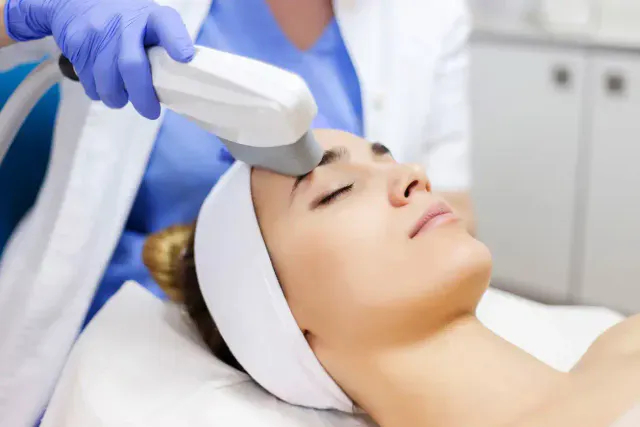
IPL emits broad-spectrum light, filtered so target tissue absorbs it selectively, acting on acne bacteria and on dilated vessels around older lesions. Stated plainly so nobody misreads it: IPL does not extract open comedones. It creates no exit for a sebum plug, and on its own it will not clear a congested nose. Its role is controlling the background — reducing bacterial activity on oily, easily inflamed skin, and fading the red marks left behind by previous breakouts. Indicated where oily skin, a tendency to inflame, or residual post-acne marks run alongside the comedones. Delivered in a series, spaced as your dermatologist directs. Skin looks slightly flushed for about an hour afterward; there is no downtime. 370,000 VND per session.
Hydration electrophoresis
After extraction, the pore has just been instrumented and the barrier in that area is temporarily weaker than usual. Electrophoresis uses a very low-intensity current to carry soothing, hydrating actives into the superficial layers, shortening the flushed phase and easing the tight, stinging feeling that can follow a session. This is a recovery step, not a cleansing one — it does not replace extraction or a peel. Indicated after extraction over a wide area, or for thin, easily irritated skin. Performed within the same visit, with no downtime. On this page it is not sold standalone; it sits inside the comprehensive combo at 1,610,000 VND per session.
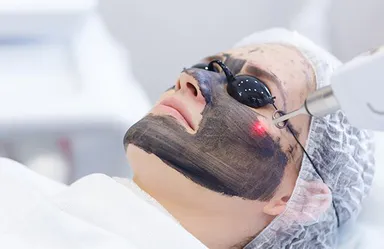
Carbon Peel — Spectra Laser (narrow indication)
A carbon suspension is applied and allowed to settle into the pore openings, then the Spectra laser fires short pulses that break up that carbon layer along with the sebum and dead cells clinging to it, while acting on the sebaceous gland and acne bacteria. This is a narrow option rather than a default step: it comes up when skin is heavily oily, pores are visibly dilated and comedones re-form quickly after each extraction, and only where your dermatologist judges it appropriate. Skin looks flushed afterward with no crusting, but sun avoidance matters for the following days. 2,750,000 VND per session.
Why choose this treatment
Treatments & pricing
100% of treatments are performed by dermatology specialists. Prices do not include 8% VAT. Contact us for a direct assessment and an exact quote based on your skin, severity and target area.
| Treatment | Price |
|---|---|
IPL technology for acne, inflammation and dark spots | 370.000 VND |
Oily & acne-prone skin care program — clearing and brightening (MA1) | 760.000 VND |
Renewing regional peel | 790.000 VND |
Dermalogica peel for brighter, clearer, less-marked skin | 890.000 VND |
Body acne peel (neck / underarms / upper back) | 890.000–2.200.000 VND |
Premium combo — deep extraction + brightening complex | 910.000 VND |
Dermalogica 3-Layer Peel | 1.100.000 VND |
INNOA ESTHETICS intensive peel for deep-seated, inflamed acne | 1.400.000 VND |
Full-face renewing peel | 1.500.000 VND |
Comprehensive combo — extraction + renewal complex + Aqua Hydro hydration + Nano C for post-acne dark-spot reduction | ~~1.900.000 VND~~ 1.610.000 VND |
Carbon Peel — Spectra Laser (oil and bacteria control) | 2.750.000 VND |
5 steps, clinically led
Step 1: Multi-layer skin exam — free
Your dermatologist examines the skin to separate open comedones, closed comedones and sebaceous filaments area by area, and reads oil production, stratum corneum thickness and any remaining post-acne marks. This step costs nothing, including if you decide not to treat.
Step 2: Protocol and itemized quote before anything starts
From the exam, your dermatologist selects the steps for the first session and estimates the rhythm of the ones after it, then itemizes each line and its cost so you decide before any procedure begins.
Step 3: Cleansing, keratin softening and pore dilation
Makeup removal and deep cleansing of the treatment area, then softening the keratin sealing the follicular neck and dilating the pore. This step is what decides whether plugs leave through an existing exit or under pressure.
Step 4: Extraction along the follicular axis with sterile instruments
The planned technique is performed area by area, drawing each plug out along the axis of the follicle, and only where the plug is ready. Anything not ready is left for the next visit — clearing an entire face in one sitting is the fastest way to tear a follicular wall.
Step 5: Barrier recovery, aftercare briefing and scheduled review
The treated area is calmed and the barrier supported within the same session. You leave with day-by-day aftercare and a review appointment, so your dermatologist can assess response and adjust the plan rather than repeat an identical session.
Make results last
Cleanse gently, and retire the scrubbing habit
Wash twice a day with a gentle product, using the water rather than your hands to do the work. For the first days after extraction, keep grit scrubs and cleansing brushes off the treated area: the pores are wider than usual and the barrier has not fully closed. If exfoliation is part of your routine, switch to a chemical exfoliant at the frequency your dermatologist sets rather than a physical one — the difference between the two is worth understanding, and it is covered in our guide to treating blackheads at home.
Choose base makeup and sunscreen by texture
The T-zone is where product settles most, so texture matters as much as ingredients: favor lighter formulas, and cleanse thoroughly every evening even on days when you only wore sunscreen. Daily sun protection stays non-negotiable, because a mark where a comedone was extracted will darken and take longer to fade if it is exposed.
No strips, no home extraction, no letting it build up
This is the part that decides the long-term result. Pore strips and a drugstore extraction tool put freshly treated skin straight back into the old loop. Rather than letting comedones accumulate for months and then attacking them with force, keep the maintenance extraction schedule you were given — plugs removed while still shallow leave a pore that has not had time to stretch, and that is how pores stay the size they are.
Support the barrier between sessions
Skin that has just been extracted or peeled needs adequate hydration and calming before the next session, particularly on a tighter treatment schedule. Where skin is thin or flushes easily, your dermatologist may add a deep hydration and recovery step between visits.
When to come back
Come in if the comedones are spreading quickly and starting to be accompanied by red, tender papules, or if you extracted something yourself and the area is more swollen and warmer after 24 hours. At that point the problem has moved from open comedone to inflammation, and treating it early is considerably simpler than waiting another week.
Still have questions?
Do blackheads go away on their own?
Is it bad to squeeze blackheads on your nose?
Do pore strips actually work?
How long does it take to get rid of blackheads?
Does blackhead extraction hurt or leave scars?
Why do blackheads keep coming back?
Shine with confidence in clear, radiant skin
Start your skin story.
Schedule your diagnostic session. Our doctors will map your unique skin biology to build a lifelong protocol for health.