WeDo Skin Clinic
Consult a dermatologist

Personalized plans — effective & safe

Book a consultation
Hotline: (+84)-898898875
Zalo chatCall nowMessengerLocation
Rosacea Treatment in Ho Chi Minh City: Calm the Redness, Control the Flares
Services & Treatments

Rosacea Treatment in Ho Chi Minh City: Calm the Redness, Control the Flares

Rosacea is manageable, not curable. Dermatologist-led redness control in HCMC — free skin exam and diagnosis, English-speaking clinic, District 1 & 2.

Medically reviewed by Dr Quynh Trang, Dermatologist (HCMC) · Updated August 1, 2026

If facial redness has stopped going away, rosacea treatment is about control rather than cure — the condition is chronic, and no honest clinic will tell you otherwise. Treatment is three things running in parallel: identifying and avoiding your triggers, medication prescribed by a dermatologist after an examination, and light-based steps to bring the background redness down once your doctor judges the skin ready. The first matters most, because rosacea is routinely mistaken for acne — and an acne routine (strong exfoliation, drying products, unlabeled creams used for months) makes a red baseline worse. At WeDo in Ho Chi Minh City, District 1 and District 2, a dermatologist examines your skin and runs a multi-layer skin analysis free of charge to confirm the diagnosis and identify which subtype dominates. There is no packaged rosacea course, so your protocol and its cost are quoted after that consultation; the published light-based steps start at 330,000 VND per session.

If you are not yet sure which condition you are dealing with, start from the overview of skin conditions treated at WeDo and come back.

## Is rosacea curable?

No — and that answer belongs at the top of the page rather than at the bottom.

Rosacea is a chronic inflammatory condition of the central face: forehead, nose, cheeks and chin. It shows up as episodes of flushing, a persistent red baseline between those episodes, small blood vessels that become visible over time, and in some people papules and pustules sitting on top of skin that is already red.

It runs in cycles — flares and quiet stretches — and the line between them depends heavily on whether you have run into your own triggers. So the goal is not to erase the condition but three measurable things: bring the background redness down, make flares less frequent and less severe, and limit progression toward the thickened-skin stage.

The cause is still not fully established, and several other conditions produce facial redness that looks very similar — which is why a dermatologist examines and images the skin before naming anything, instead of diagnosing from a phone photo. For the background reading, our general article on rosacea goes deeper than this page does.

### What good control looks like

– A visibly calmer baseline on days with no trigger exposure, instead of steady redness year-round. – Flares that arrive less often, run milder, and settle faster than they used to. – Less stinging and burning, and skin that tolerates a gentle cleanser and moisturizer without reacting.

There is no “clear in X weeks” milestone here. Your dermatologist reassesses the baseline redness and the flare pattern at each follow-up and adjusts from what the skin is actually doing.

## Rosacea vs acne: how to tell them apart

Early on, the two look close enough that patients cannot reliably separate them alone — the most common reason rosacea gets treated the wrong way for months, sometimes years.

### A quick side-by-side

| Common acne | Rosacea | |—|—| | Comedones present: visible blackheads and whiteheads | No comedones — this is the most useful distinguishing sign | | Scattered across forehead, cheeks, chin, often back and chest | Concentrated on the central face: nose, cheeks, mid-forehead, chin | | Skin between lesions is usually not persistently red | Persistently red baseline even when no lesions are present | | Discomfort is mainly soreness at the inflamed lesion | Stinging and burning, with easy irritation from ordinary topicals | | Little relation to heat, spicy food or alcohol | Flares with strong sun, heat, spicy food, hot drinks, alcohol | | Typically starts in the teens | Typically starts after 30, often in people who flush easily |

This table is orientation, not a self-diagnosis tool: the conclusion needs a clinical exam and skin imaging, not least because both conditions can be present on the same face.

### What happens when rosacea is treated like acne

The skin barrier in rosacea is already weakened and loses water more easily than normal skin. Strong exfoliation, drying products, at-home peel masks and long-term use of self-prescribed creams all hit exactly that weakness: the barrier thins, tolerance drops, and the redness ends up worse than before treatment began. If you genuinely do have comedones and inflamed lesions, the right route is a medical acne protocol — but that is a different condition with a different plan.

### Other conditions that cause facial redness

Seborrheic dermatitis can accompany rosacea or be mistaken for it, since both cause redness and light flaking around the T-zone. Contact dermatitis from a cosmetic also leaves skin red and sore, but usually starts with one new product and stays within the area it was applied to. Post-inflammatory darkening is different again — brown pigment rather than vascular red, which is why it belongs with melasma and brown-spot treatment and responds to different wavelengths. Only an examination separates these reliably.

### Facial redness on olive and deeper skin tones

On olive and deeper skin tones, facial redness often reads as dusky, brownish or violet rather than pink, and visible vessels are harder to spot — a well-documented reason rosacea is under-diagnosed in patients who are not fair-skinned. Diagnosis then leans on symptoms as much as color: flushing episodes, stinging, burning, and skin that reacts to products it used to tolerate. Our note on how olive skin tones behave covers the same principle elsewhere, and this account of rosacea as a hidden skin condition shows the misdiagnosis pattern in a real patient.

## The four types of rosacea, and how to recognize yours

One person can have more than one type at once. Whichever dominates decides the direction of treatment, and identifying it is the dermatologist’s job during the skin exam, not a box you place yourself in.

### Flushing and visible blood vessels

The type most people notice first, because it is visible: a persistent red baseline over the cheeks and around the nose, with fine thread-like vessels showing up close. The skin flushes fast in heat — stepping from the street into air conditioning, a hot pot dinner, a flight of stairs. Flushing settles; vessels that have already dilated tend to persist and become more obvious over time. Vascular-targeted light and laser are mainly indicated for this type, once your dermatologist judges the skin stable enough.

### Papulopustular rosacea: papules and pustules

Red papules and pustules on skin that is already red, usually over the cheeks and around the nose, without blackheads or whiteheads. Papulopustular rosacea is the most frequently misdiagnosed type and suffers most when managed as acne. Direction is decided by the dermatologist after examination and generally involves prescribed medication; light-based steps enter only once the inflammation has settled.

### Thickened skin (phymatous change)

In later-stage disease the tissue of the nose can thicken, pores enlarge and the surface becomes irregular. It is seen more often in middle-aged men and develops slowly over years. This needs specialist assessment and can fall outside what an aesthetic dermatology clinic should be doing; your dermatologist will say plainly what the right route is, including referral onward. This page makes no promise to treat phymatous change and quotes no price for it.

### Ocular rosacea: when to see an eye doctor

Rosacea is not confined to skin. Some people get a gritty foreign-body sensation, dryness, burning, red or slightly swollen eyelid margins, and this can occur even when the facial skin is only mildly red. If you have any eye symptoms, see an eye specialist: do not self-treat with drops, and do not have light-based treatment around the eyes before an eye doctor has assessed you.

## What triggers rosacea flare-ups in a tropical climate

Most trigger lists in circulation were written for temperate countries. In Ho Chi Minh City the practical set is different — and identifying yours is the cheapest part of treatment, because you do it yourself.

### Sun, heat and the commute

The UV index here is high almost year-round, overcast days included, and the load is higher than most arrivals are used to at home. Riding a motorbike in the middle of the day stacks heat, wind and traffic pollution onto the central face at once — for many patients the strongest trigger they never suspected. Moving in and out of air conditioning all day swings skin temperature sharply and keeps facial vessels dilating and constricting; saunas and very hot showers sit in the same group.

### Food, drink and daily life

Spicy food and hot pot, hot drinks, beer and spirits, hard exercise in the heat, poor sleep and sustained stress are all commonly reported as making flares worse. To be precise: these do not cause rosacea. They push already-sensitive skin past its threshold — and that threshold differs from person to person, which is why no universal avoidance list exists.

### What you put on your face

Cosmetics with alcohol and fragrance, scrub-type exfoliants and peel-off masks all act mechanically or chemically on a barrier that is already compromised. The bigger problem in this market is unlabeled products used for months: the skin usually looks brighter and clearer at first, but the mechanism behind that is a thinning, weakened barrier — so when the product stops, the redness rebounds worse than it was at the start.

### A trigger diary: finding your own threshold

Four lines, each time the skin flares unexpectedly:

Date and time the flare started. – Suspected trigger: what you ate, where you went, any new product in the previous 24 hours. – Redness 1 to 5, scored your own way, consistently. – How long until it settled: hours, a day, or several days.

After three or four weeks the repeating patterns surface on their own, and they are usually surprising. Bring the diary to your follow-up — it tells your dermatologist more than any description from memory does.

## How rosacea treatment works at WeDo

The plan rests on three pillars, and their order matters as much as their content.

First, differential diagnosis. The first appointment is not a treatment appointment. A dermatologist runs a multi-layer skin analysis to rule out the other conditions that cause redness, confirm this is rosacea, and establish which subtype dominates. Doing anything to the skin before that is a gamble, and the price of guessing wrong is further barrier damage. You can read about the dermatology team practicing in Vietnam beforehand, or see the clinic’s doctors.

Second, prescribed medication plus barrier repair. This settles the inflammation and brings the condition back to a stable state. Medication is prescribed by your dermatologist after examination, based on your subtype, severity and history, and billed separately from anything listed on this page.

Third, light-based redness support, when indicated. This is genuinely a supporting step. It works on the background redness and on vessels that have already dilated, but it does not replace the first two pillars and is not started while skin is in an acute flare.

### Laser treatment for rosacea: what light can and cannot do

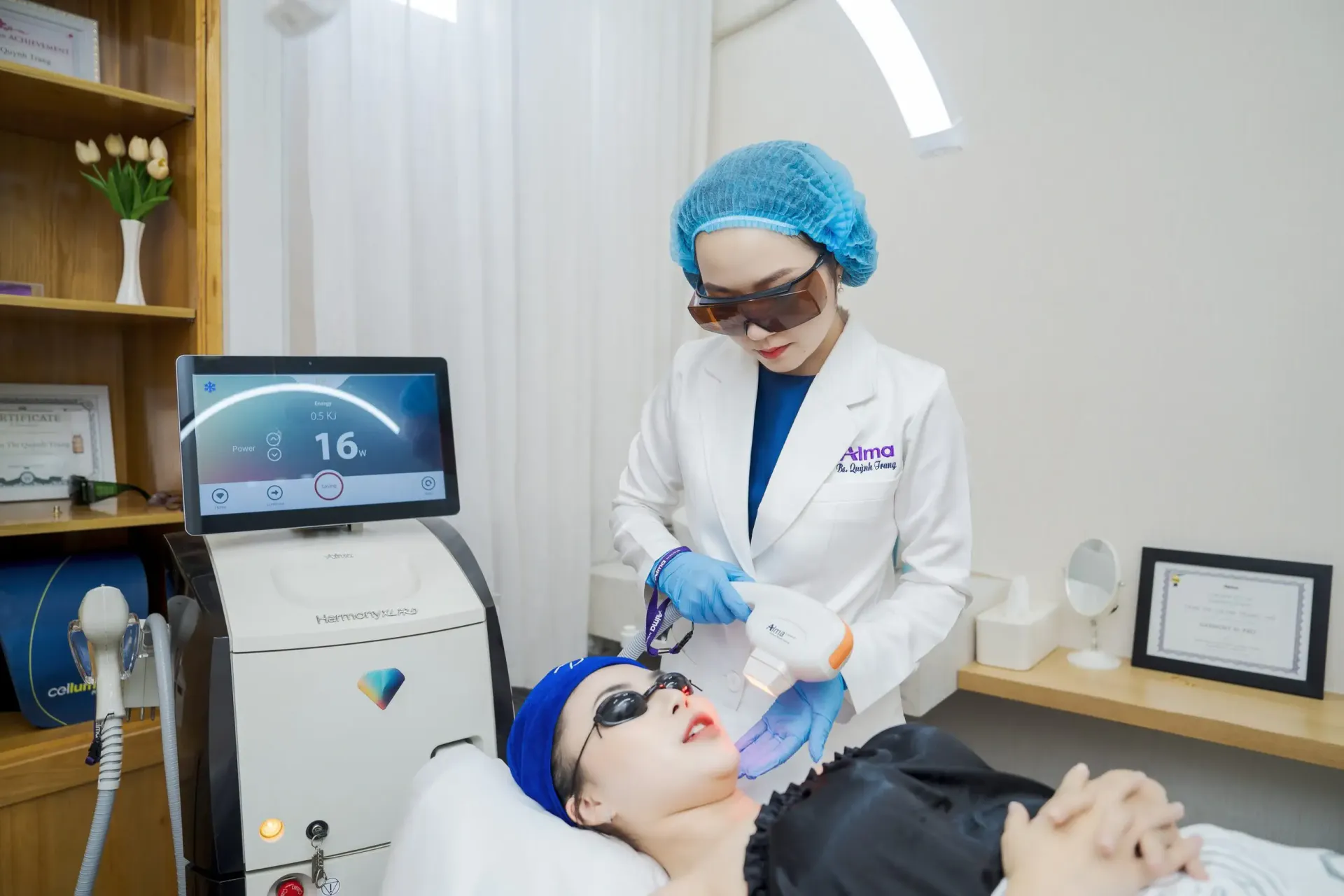
Vascular light and laser deliver wavelengths that hemoglobin absorbs strongly, so the energy is taken up inside small superficial vessels and converted to heat there while surrounding skin is left comparatively alone. Over a course of sessions those vessels shrink and fade, and the diffuse red baseline lifts. What light does not do is change the underlying condition: it is symptomatic improvement on top of medical control, and triggers left unmanaged will bring redness back. The technologies are described below and in more detail on the LED light therapy, IPL and Dye VL by Alma Harmony pages; the full device list is on the technology page.

## Visiting Vietnam or living here?

WeDo consults in English, and a meaningful share of our rosacea patients are expatriates and visitors — often people managed for years elsewhere who want a fresh assessment. Both clinics are central, in District 1 and District 2, and the consultation and skin analysis are free, so a first visit costs time rather than money.

Be realistic about what one visit achieves. Rosacea is long-term, so a single appointment during a short trip gives you a diagnosis, a written plan and the start of stabilization — not a finished course. That is still worth doing, particularly if nobody has confirmed the subtype before. Bring two things: a photo of your skin on a bad day, since you may well arrive on a good one, and a list of everything you currently put on your face.

For context on how treatment here works for people from abroad, see our notes on skin treatment for foreigners in Vietnam and what an international skincare clinic should offer, plus one international patient’s experience after a Dye VL session and the wider patient stories.

There is no packaged rosacea course, so the full protocol is quoted after the free consultation. The published light-based items are in the table below and in the full price list; to start with the skin exam, book a free consultation.

The technology

How it works

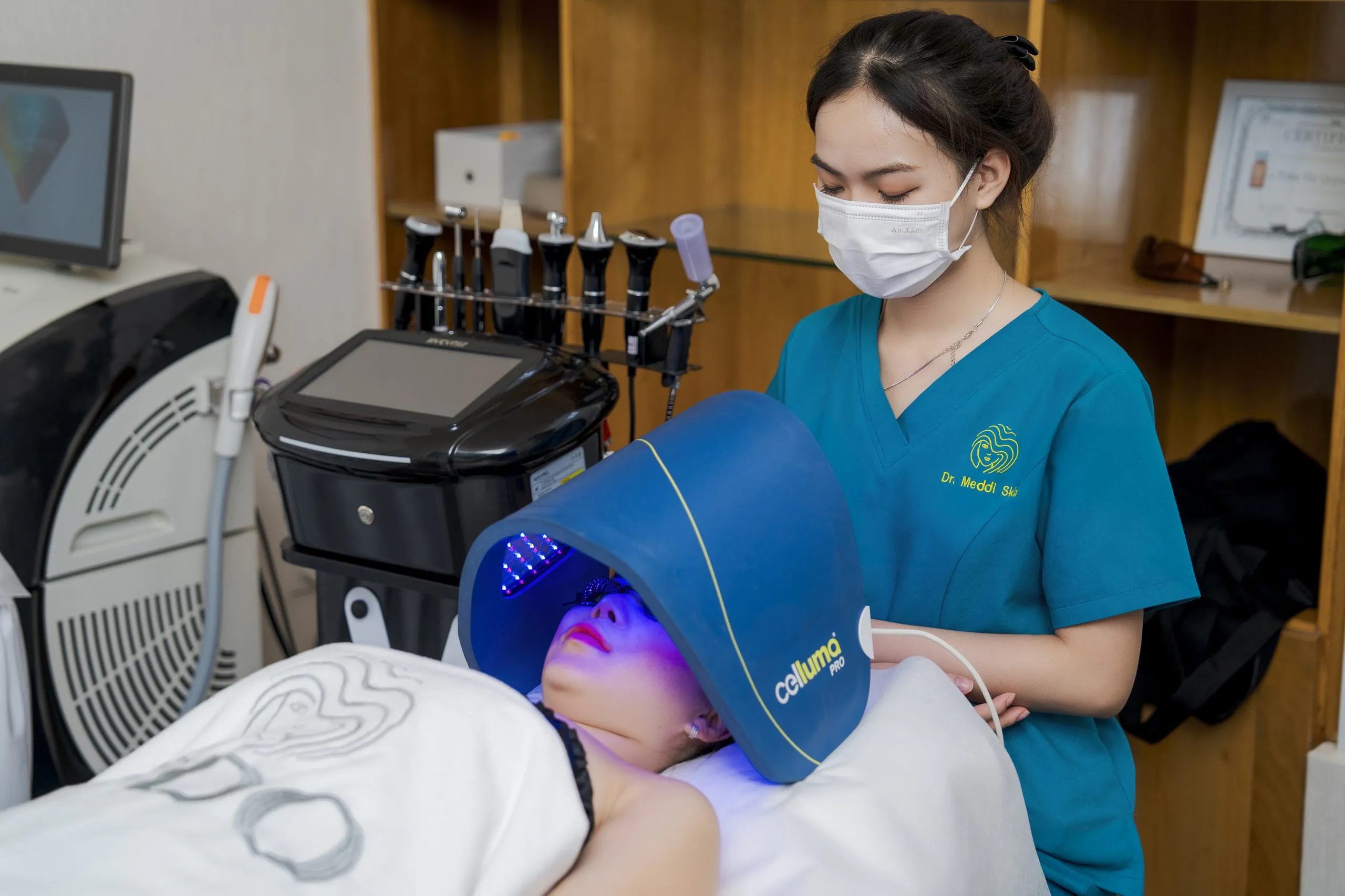
Celluma LED therapy — calming the skin after a flare

LED light in the red and near-infrared range reaches the superficial layers of skin without meaningful heat, acting on cell activity in a way that reduces inflammatory signaling and supports repair. With no heat and no ablation, this is usually the gentlest intervention a rosacea-prone face tolerates straight after a flare. Indicated for: skin still red and reactive following inflammation, needing to be calmed before anything stronger is considered. Session counts are indicative — typically a run of sessions a few days apart, set by your dermatologist from your response. No downtime. 330,000 VND per session. Not suitable for: anyone with unassessed eye symptoms, recently sunburned skin, or anyone using a prescribed product that increases light sensitivity.

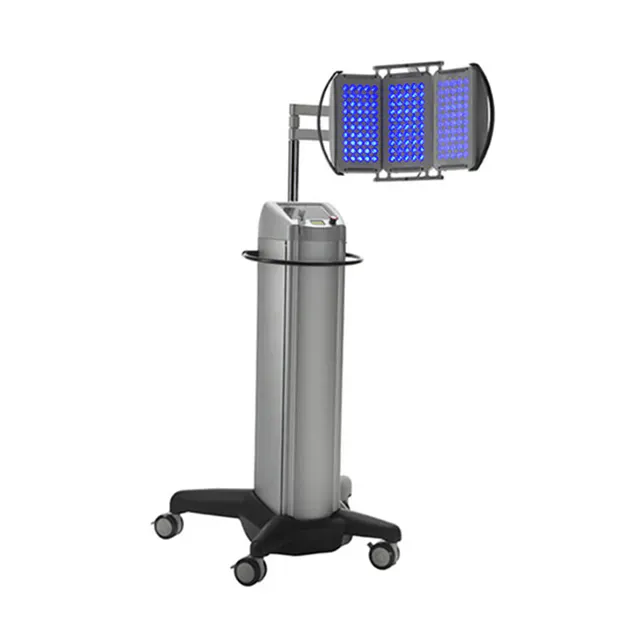
Photocare Premium LED

The same photobiological principle as Celluma at a different wavelength and power configuration, letting your dermatologist match the spectrum more closely to a particular skin. Indicated for: maintenance between flares, or when a different spectrum is wanted to gauge response. Session counts are indicative and run in courses rather than fixed packages. No downtime. 480,000 VND per session. Not suitable for: the same situations as Celluma — unassessed eye symptoms, recently sunburned skin, or an uncontrolled acute flare.

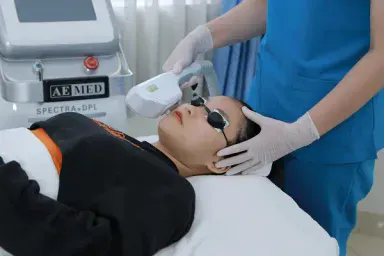
IPL for rosacea — broad-spectrum light on a red baseline

IPL emits a broad band of light, and the portion strongly absorbed by hemoglobin generates heat inside small superficial vessels so they contract and fade across a course of sessions. Because the effect spreads over an area, it suits diffuse redness across the cheeks better than a few isolated vessels. Indicated for: a diffuse red baseline past the acute inflammatory phase, with mild to moderate visible vessels. Session counts are indicative — usually several sessions a few weeks apart, judged by your dermatologist. Skin may look pinker for a few hours and then settle; absolute sun protection is required afterward. 370,000 VND per session. Not suitable for: skin in an acute flare, recently sun-exposed or sunburned skin, unassessed eye symptoms, or anyone using a prescribed product that increases light sensitivity.

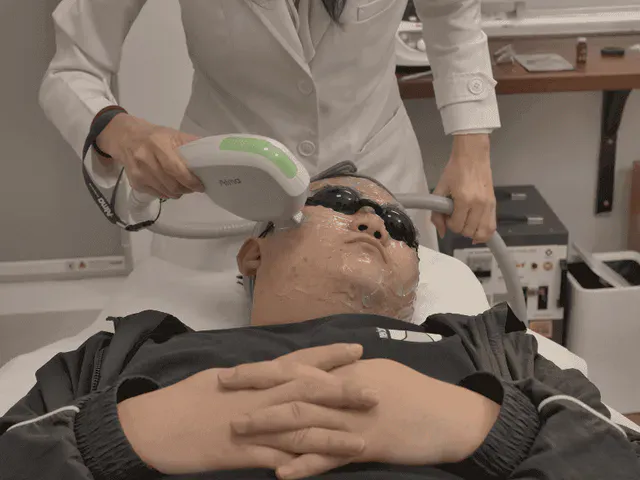
Dye VL (Alma Harmony) — selective wavelengths for superficial vessels

Dye VL narrows the emitted band to the range hemoglobin absorbs most strongly, so more energy lands on the vascular target and less spreads into surrounding tissue than with broad-spectrum light. In practice that lets your dermatologist address the red baseline at a restrained energy level on skin that reacts easily. Indicated for: a persistent red baseline and superficial dilated vessels in patients past the acute phase whose barrier has substantially recovered. Session counts are indicative and set by response rather than sold as a package. Mild redness for a few hours is expected; absolute sun protection afterward. From 1,700,000 VND per session, depending on the area treated and the plan. Not suitable for: skin in an acute flare, recently sunburned skin, unassessed eye symptoms, or anyone using a prescribed product that increases light sensitivity.

Barrier repair between sessions

A large share of the result on rosacea-prone skin comes not from a device but from rebuilding the barrier. This group covers calming, deep hydration and recovery methods prescribed by your dermatologist and scheduled between light sessions so the skin holds its tolerance threshold. Indicated for: thin, reactive skin, persistent stinging, or skin recovering from unsuitable products. Session counts are indicative and decided from the state of the barrier. No meaningful downtime. Cost is quoted separately after the consultation, because it depends on the method chosen. Not suitable for: broken skin or an uncontrolled acute flare.

Advantages

Why choose this treatment

A dermatologist examines and images the skin to rule out the other causes of facial redness before calling anything rosacea.
The plan follows whichever subtype dominates on your skin rather than applying one fixed package to everyone.
We say from the first appointment that this is a chronic condition needing long-term follow-up, instead of promising a cure.
Light-based redness support is priced item by item and published; prescribed medication is quoted separately by your dermatologist.
Consultation, skin analysis and follow-up visits are free throughout, including visits that only reassess the baseline redness.
Clinics in District 1 and District 2, consulting in English for residents and visitors alike.
Pricing

Treatments & pricing

100% of treatments are performed by dermatology specialists. Prices do not include 8% VAT. Contact us for a direct assessment and an exact quote based on your skin, severity and target area.

General skin consultation + multi-layer high-tech skin analysis + follow-up consultation with a board-certified dermatologist
FREE
TreatmentPrice
Celluma USA LED therapy for recovery and redness reduction
330.000 VND
IPL technology to reduce inflammation and redness
370.000 VND
Photocare Premium LED technology
480.000 VND
Dye VL (Alma Harmony) — selective light to calm redness and even out skin tone
1.700.000 - 2.200.000 VND
Prices do not include 8% VAT

See the full price list

Treatment process

5 steps, clinically led

1

Step 1: Skin imaging and clinical examination — free

A dermatologist runs a multi-layer skin analysis and examines you directly. The first objective is not choosing a device; it is separating rosacea from the other conditions that cause redness, because every decision after this depends on that conclusion.

2

Step 2: Subtype identification and a personalized plan

Your dermatologist establishes which type dominates — flushing and visible vessels, papulopustular, phymatous, or with ocular involvement — builds the plan around it, and quotes the full cost of that plan at this step, before you decide anything.

3

Step 3: Settling the flare

Prescribed medication is started alongside barrier repair and the removal of whichever triggers are currently active. This is the phase that brings the condition back to a stable state.

4

Step 4: Light or vascular laser support for the red baseline

Begun only when your dermatologist judges the skin stable enough. The technology group is chosen by subtype and by how much the skin tolerates, with intervals set by real response rather than a fixed calendar.

5

Step 5: Long-term follow-up

Scheduled review visits, the trigger diary read through together, the baseline redness reassessed, and the plan adjusted by season and by flare pattern. Rosacea stays with you, so follow-up matters as much as treatment.

FAQ

Still have questions?

Is rosacea curable?
Rosacea is a chronic inflammatory condition, so there is currently no cure for it. Treatment aims at control: bringing down the background redness, making flares less frequent and milder, and limiting progression toward thickened skin. Many people hold a stable, comfortable baseline for long stretches once their triggers are identified and follow-up is consistent.
What is the difference between rosacea and acne?
The clearest distinguishing sign is comedones: acne produces blackheads and whiteheads, rosacea does not. Rosacea also leaves a persistently red baseline between lesions, concentrates on the central face, comes with stinging or burning, and usually starts after the age of 30. Only a clinical exam with skin imaging settles it.
Does IPL or laser treatment work for rosacea?
Vascular light and laser can reduce the background redness and fade dilated vessels, which is a real and visible improvement. They are a supporting step rather than a cure, though, and they do not replace prescribed medical treatment. The skin also needs to be reasonably stable first, so your dermatologist assesses it before recommending any light-based session.
What triggers rosacea flare-ups?
There is no universal list, because each person has a different threshold. In a tropical climate the common ones are strong sun and UV exposure, heat, the motorbike commute, sharp air-conditioning temperature swings, spicy food, hot drinks, alcohol, saunas and very hot showers. Keeping a trigger diary for a few weeks and reviewing it at your follow-up is the most reliable way to find yours.
Is rosacea contagious?
No. Rosacea is not an infection and does not pass from person to person through contact or shared items. It is more common in people with affected relatives, but that reflects individual predisposition rather than transmission.
Can rosacea be treated on darker skin tones?
Yes, and the treatment principles are the same — but diagnosis is harder, because on olive and deeper skin tones redness reads as dusky or brownish rather than pink and visible vessels are less obvious. Diagnosis therefore leans more on symptoms such as flushing, stinging and burning. Light-based settings are also selected more conservatively on deeper skin tones, which your dermatologist assesses at the examination.
How much does rosacea treatment cost in Ho Chi Minh City?
There is no fixed rosacea package, so the cost depends on your subtype and severity and is quoted by your dermatologist after the consultation. At WeDo the consultation and multi-layer skin analysis with a dermatologist are free; the published light-based steps start at 330,000 VND per LED session and from 1,700,000 VND for Dye VL. Prescribed medication is billed separately.

Shine with confidence in clear, radiant skin

Start your skin story.

Schedule your diagnostic session. Our doctors will map your unique skin biology to build a lifelong protocol for health.

11 TRẦN DOÃN KHANH, QUẬN 1
17 THÁI THUẬN, QUẬN 2

Include your country code, e.g. +84-857466767