Dr. Anh Thu, MD — Specialist Level II DermatologistMar 27, 20263 min read
Folliculitis can affect anyone and may occur anywhere on the body except the palms and soles. Although it does not impact overall health, it often causes discomfort and reduces confidence due to cosmetic concerns. Without proper treatment, folliculitis tends to recur, making the skin appear less smooth.
FOLLICULITIS – DEFINITION AND SIGNS AND SYMPTOMS
Folliculitis is an infection of the hair follicles. Therefore, any area containing hair follicles can be affected. This means that, except for the palms and soles, folliculitis may occur on any part of the body. In particular, moist areas such as the axillae, groin, genital–perianal region, and buttocks have a higher incidence of folliculitis.
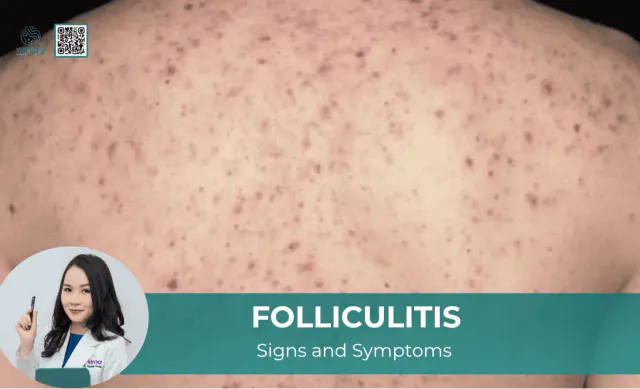
Typical manifestations of folliculitis include erythematous papules or pustules centered on hair follicles, surrounded by an erythematous halo. When the lesions rupture, they leave small erosions that subsequently form crusts. The lesions may appear as a few scattered papules, or cluster into inflamed patches in areas such as the moustache or beard region. Symptoms of folliculitis vary; some individuals experience no discomfort, while others may report pruritus or a burning sensation.
When folliculitis occurs, the follicular openings become erythematous and swollen, leading to cosmetic concerns and, in some cases, pruritus and discomfort.
CAUSES OF FOLLICULITIS
In most cases, folliculitis is commonly caused by Staphylococcus. In addition, Gram-negative bacteria, Pseudomonas, Proteus, yeasts, dermatophytes, herpes virus infection, molluscum contagiosum, and the parasite Demodex may also lead to this condition.
The risk of developing folliculitis increases under the following conditions:
Hot climate, high humidity, polluted or dusty environments
Shaving, plucking, or hair removal
Wearing clothing made from synthetic fibers or occlusive dressings
Use of topical or oral medications. Specifically, prolonged use of topical corticosteroids or long-term antibiotic therapy may promote the growth of anaerobic bacteria.
TREATMENT OF FOLLICULITIS
If the immune system is strong, a folliculitis flare may resolve spontaneously after discontinuing triggering activities (such as stopping shaving or discontinuing topical medications). However, in many cases, medical treatment is required.
According to PhD. Nguyen Duy Hung – National Hospital of Dermatology and Venereology, folliculitis can be treated using the following approaches:
1. Topical treatment: anti-infective topical agents such as Betadine, iodine alcohol, or antibiotic creams/ointments such as Bactroban and Fucidin may be used.
2. Systemic treatment: in severe or recurrent cases, systemic medications may be required.
Antibiotics: in staphylococcal folliculitis, systemic antibiotics may be prescribed when necessary. Options include beta-lactam antibiotics, amoxicillin, cephalosporins, cyclines, co-trimoxazole, ciprofloxacin, and metronidazole. Dosage and administration depend on disease severity and manufacturer guidelines.
Gram-negative bacterial folliculitis: discontinue current antibiotics, cleanse with benzoyl peroxide, and administer ampicillin or co-trimoxazole. In some cases, isotretinoin may be indicated.
Fungal folliculitis: topical antifungal agents combined with oral therapy. Topical medications include Nizoral, Canesten, and Mycoster. Oral antifungals include itraconazole 100 mg, two capsules daily for 14 days, or terbinafine 250 mg daily for 14 days. For Candida infections, itraconazole 100 mg, two capsules daily for 14 days, or fluconazole 150 mg, two capsules daily for 14 days may be used.
Herpes virus-related folliculitis: topical acyclovir cream applied six times daily, combined with oral acyclovir 400 mg three times daily or 200 mg five times daily, or valacyclovir 500 mg twice daily.
Demodex-related folliculitis: permethrin cream or metronidazole cream may be used, combined with oral metronidazole 1 g daily for one week.
HOW TO PREVENT FOLLICULITIS?
Folliculitis can be prevented by:
Wearing loose clothing in hot and humid weather. When tight clothing is required for exercise, shower and change into loose clothing immediately afterward. Avoid creating a moist environment.
Washing clothes after each use and allowing them to dry naturally.
Applying topical medications properly: apply in the direction of hair growth and avoid occluding the treated area whenever possible.
CONCLUSION
Although folliculitis is not dangerous, to restore smooth skin quickly, it is advisable to consult a dermatologist for evaluation and an appropriate treatment plan when necessary.
Follow Services & Treatment to stay updated on safe, effective, and sustainable aesthetic solutions.
Dr. Anh Thu completed her entire formal and advanced clinical training at the University of Medicine and Pharmacy at Ho Chi Minh City (UMP HCMC), the top-tier medical institution in Southern Vietnam:
Doctor of Medicine (MD) – University of Medicine and Pharmacy at Ho Chi Minh City.
Specialist Level I in Dermatology – University of Medicine and Pharmacy at Ho Chi Minh City.
Specialist Level II in Dermatology(Senior Consultant Level) – University of Medicine and Pharmacy at Ho Chi Minh City.
Continuous Medical Education (CME) & Certifications:
Certification: Laser, Radiofrequency (RF), and High-Intensity Focused Ultrasound (HIFU) in Aesthetic Dermatology (UMP HCMC).
Certification: Specialized Dermal Filler Injections in Aesthetic Medicine (UMP HCMC).
Certification: Advanced Clinical Practice of Botulinum Toxin Injections (UMP HCMC).
Certification: Medical Thread Lifting Techniques (UMP HCMC).