
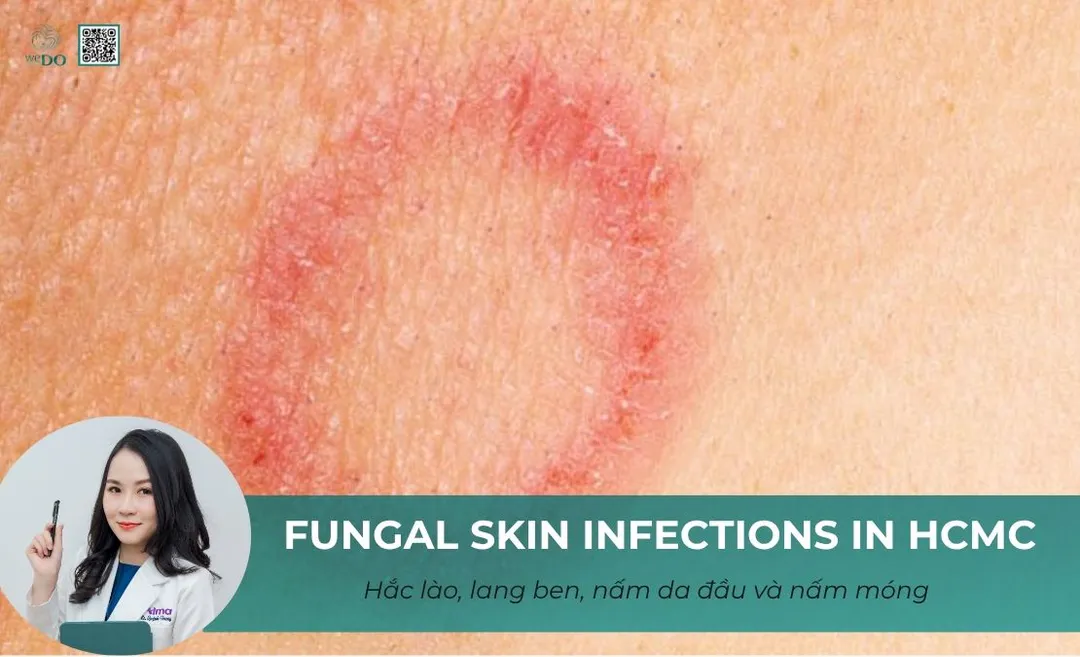
Fungal Skin Infections in HCMC: Ringworm, Tinea Versicolor, Scalp & Nail
Ringworm, tinea versicolor, scalp and nail fungus: how they spread, warning signs and reinfection control. Free dermatologist exam in Ho Chi Minh City.
Medically reviewed by Dr Quynh Trang, Dermatologist (HCMC)
Each type of fungal skin infection varies in its affected areas, mode of transmission, and treatment duration. Therefore, there is no standard cost for “fungal skin infection treatment.” The doctor will assess the condition, determine its type and severity, and provide a specific treatment plan and cost after the consultation.
Our clinics are in District 1 and District 2, and consultations are held in English. This page covers fungal skin infections specifically; for the wider picture of the conditions we treat, start from treatment of skin diseases at WeDo. If your rash is dry, itchy and red but has no raised advancing edge and does not spread in a ring, the more likely picture is atopic dermatitis — a different group of conditions, managed along completely different lines.
How it works
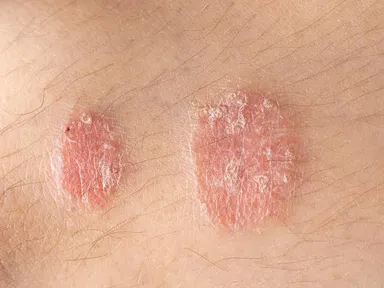
Ringworm, jock itch, athlete's foot: the common forms of fungal skin infection
Start with the words, because English makes this confusing in one specific way: ringworm is not a worm. It is a fungal infection of the skin, named centuries ago for the shape of the rash rather than its cause. Nothing is burrowing under your skin, and the treatment has nothing to do with worms. That one sentence saves a great deal of unnecessary alarm. The clinical names map onto the everyday ones fairly simply. Ringworm on the body is tinea corporis. Jock itch, in the groin, is tinea cruris. Athlete's foot, between the toes, is tinea pedis. Tinea versicolor is the one that leaves pale or dark patches on the trunk. Scalp and nail infections are usually just called that. Same family of organisms, different territory — which is exactly why they are not managed identically. Ringworm on the body is the form most people picture. A red, ring-shaped patch with a raised, clearly defined edge that expands outward while the center fades back toward normal skin. It itches, more so when you sweat. It favors the trunk, the buttocks and the groin, and it typically starts in one place and grows rather than appearing symmetrically on both sides. Tinea versicolor looks nothing like that and worries people for a different reason. It shows as flat patches that are lighter or darker than the surrounding skin, with a fine scale on the surface, and it itches little or only when you sweat. The classic sites are the back, chest, shoulders and neck. Many people first notice it after a beach day, when the affected skin does not tan like everything around it and suddenly stands out. Jock itch is a red, itchy, sharply bordered rash in the groin folds, often extending onto the inner thigh. It turns up most in people who sweat heavily, wear tight clothing, or stay in damp gym kit too long after training. Athlete's foot sits between the toes: peeling, cracking, dampness, itch and odor. It gets worse in the rainy season and in anyone wearing closed shoes all day, and it is the form most often dismissed as trivial — even though it is one of the most reliable sources of reinfection to other parts of your own body. On the hands and the tops of the feet, fungal infection often appears as a dry, scaly patch, sometimes on one side only. That asymmetry is one of the things that makes a dermatologist think of fungus in the first place. One distinction matters more than the rest, because getting it wrong makes things worse. Fungal infection has a defined, raised, outward-creeping edge with central clearing. Dermatitis is a red, dry, itchy patch that may weep but has no characteristic border and does not spread in a ring. The two are treated in opposite directions, which is why a rash treated as the wrong one can spread and lose the very shape that would have identified it. Fungal infection can affect any area where moisture and friction meet, including the genital area. If that is where your rash is, have a doctor examine it rather than treating it yourself. And the point that underlies all of the above: in photographs, these forms look alike, and they look like several unrelated skin conditions too. Telling them apart with confidence requires someone examining the skin in person.
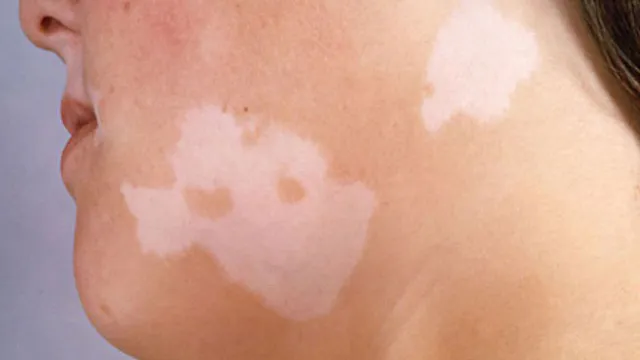
Tinea versicolor leaves pale or dark patches: is that melasma?
This is the question that arrives once the itch has settled. The skin that was infected is still a different color from everything around it, and people start to wonder whether they now have melasma. Three conditions get confused here, and the reason is easy to see: all three leave a patch of skin a different color from the skin around it, so color alone will never separate them. Tinea versicolor produces patches in several shades at once — some pale, some brown, some faintly pink — with clear edges and a fine scale that becomes visible when the surface is lightly scraped. It concentrates on the back, chest, shoulders and neck, and it becomes more obvious after sun exposure, because the affected skin does not tan the way the skin around it does. Melasma is a brown patch, symmetrical across both cheeks, sometimes extending to the forehead, the bridge of the nose and above the lip. It has no scale, it does not itch, it does not creep outward in a ring, and it changes over months rather than weeks. Vitiligo is a patch of complete pigment loss — uniformly white, sharply edged, smooth, with no scale and no itch. Unlike tinea versicolor, it is not a mixture of shades. One thing worth knowing in advance so it does not alarm you: once the fungus itself has been dealt with, the color usually takes several weeks to several months to even out. Pigment recovers far more slowly than the itch and the scale disappear, so a period of "cleared but still blotchy" skin is the normal course, not a sign that treatment failed. What that period calls for is sun protection over the recovering skin — not the start of a pigment course. If your dermatologist examines you and the real issue turns out to be melasma rather than the aftermath of tinea versicolor, that is a different problem with an approach of its own — and as with the forms above, telling these apart with confidence requires someone examining the skin in person.
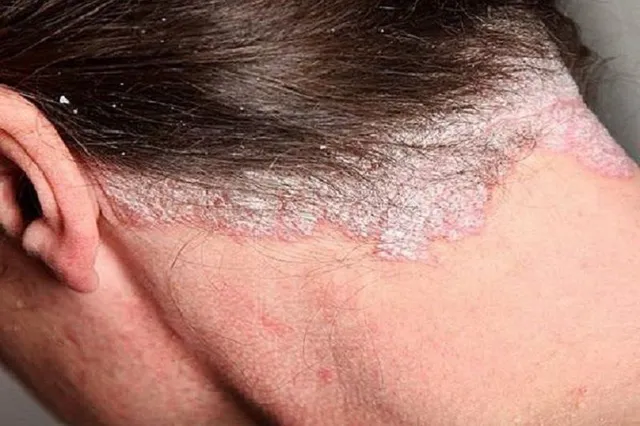
Scalp and nail fungus: why these two behave differently
These two forms are separated out because the expectations around them are genuinely different from fungal infection on the trunk — and because they are the two where waiting costs the most. Scalp fungus shows as a scaly patch of scalp with hair breaking off close to the surface, leaving a thinned or bald-looking area, usually itchy, sometimes with swelling, tenderness and enlarged glands in the neck. The important part: left long enough, it can scar and cause permanent hair loss. Once a follicle has been destroyed and replaced by scar tissue, hair does not return there regardless of later treatment. That is why a scaly patch on the scalp is not something to monitor for a few more months. This is also where confusion with ordinary hair loss does real harm. Male-pattern hair loss develops gradually over years, symmetrically, with no scale and no itch — you lose hair, but the scalp itself is not damaged. Fungal scalp infection does the opposite: it appears quickly, stays localized to a patch, scales, itches, and breaks hairs rather than shedding them whole. The two are treated along entirely different lines, so the distinction has to be made before anything else happens. For clarity on scope: dandruff and seborrheic dermatitis are a different condition, not scalp fungus, even though a yeast that normally lives on skin plays a part in them. Nail fungus has its own picture: the nail thickens, turns cloudy, discolors yellow or brown, becomes brittle and crumbly at the free edge, and may lift away from the nail bed. The single most important thing to understand before starting is that treatment is measured in months, because you are waiting for new nail to grow out and replace the damaged plate. The diseased nail itself will not become clear again; what you are waiting for is the new growth behind it. This is precisely why so many people abandon treatment halfway — they judge the result too early, see the old nail still looking wrong, and conclude nothing is working. What both forms share: they rarely clear on their own and they do not respond the way infection on the trunk responds. If yours is on the scalp or a nail, being examined early is a far better use of your time than trying one more product.
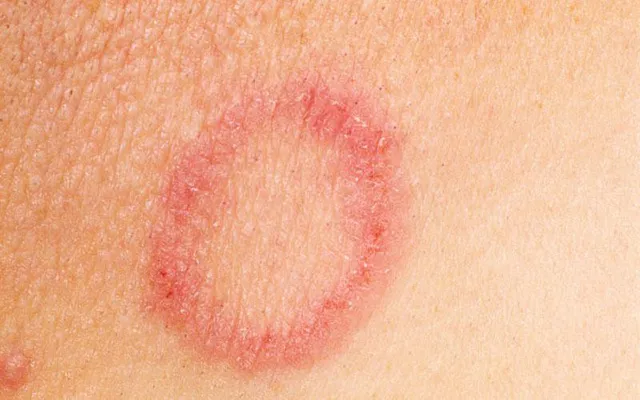
How fungal infections spread — and why they keep coming back
They are contagious, and that is the short answer to the question almost everyone asks first. Transmission runs along three routes. Direct skin-to-skin contact, most often between people sharing a home or playing contact sports. Shared personal items: towels, clothing, shoes, combs, pillows, and nail clippers. And damp shared floors — gyms, pools, changing rooms, communal bathrooms. There is a fourth route that gets missed constantly: household pets, particularly a dog or cat with a circular patch of hair loss or a new scratching habit. The more useful part is why it returns. Picture it as a loop. The fungus survives in shed skin scale, and that scale collects in shoes, socks, towels, bed linen and on the floor. Meanwhile the skin itself heals and looks normal, so treatment stops. But spores are still in the environment — or still on someone else in the household who was never treated. Given the right conditions they re-establish, usually in exactly the same spot. The loop closes and the next round begins. That is the medical explanation for the most common complaint we hear: it clears while you treat it and comes back when you stop. Not because your skin is unusually difficult, but because only half the problem was addressed. Dealing with the source in daily life matters as much as treating the skin, and your dermatologist will work through it with you against your actual living situation. If you have recently moved to Vietnam, expect your skin to behave differently for a while. A hot, humid tropical climate is one of the most common reasons a foreigner develops their first fungal skin infection, and the reasons are ordinary rather than medical. You sweat year-round, including inside closed shoes in 35 °C. You move in and out of heavily air-conditioned rooms all day, so clothes and skin never fully dry out. The rainy season leaves footwear damp for weeks at a stretch. Gym and pool floors get used far more often here than in a cooler country. None of this means anything has gone wrong with you — it means the conditions changed, and habits that never mattered before now do. To say it plainly once more: this is not a hygiene failure. Regular gym-goers, people in closed shoes for eight hours a day, heavy sweaters and outdoor workers are all in the higher-risk group. And having already tried something from a pharmacy before coming in is not a problem either — it is simply, usually, not enough.

How is a fungal infection confirmed? And when to be seen urgently
The consultation opens with questions you may not expect. Your dermatologist asks when it started and how it has behaved, what you do for work, what you wear and what shoes you spend the day in, whether there are pets at home, and whether anyone you live with has something similar — then examines the affected skin directly. The diagnosis is made on clinical examination: the shape and border of the lesion, where it sits and how it has spread are what your dermatologist reads to establish which form it is. That step earns its place for a practical reason: several unrelated conditions look like fungus, and treating in the wrong direction is not merely useless — it can spread the lesion or erase the characteristic shape, which makes the diagnosis harder afterward. The earlier you are seen, the more intact the picture is to read. One group of signs should not be watched and waited on. Be seen promptly if the rash spreads quickly over a few days or appears in several areas at once; if it involves the scalp or is breaking hair off in patches; if it involves a nail; or if it is on the face or around the eyes. Come in if the area becomes swollen, hot and increasingly painful, starts to discharge, forms yellow crusts, or you develop a fever — those suggest secondary infection, which needs treating in its own right. Come in if there is significant pain or pustules, if the skin has not improved after a prescribed course, if the problem keeps recurring, or if several people in the household have it. And come in early if you are pregnant, taking immunosuppressive medication, or living with a condition such as diabetes, because those change both how the infection behaves and how it can be prescribed for. This list exists so that you get seen — not so that you can diagnose or manage yourself at home. So what does a plan actually look like? Your dermatologist examines the skin and establishes the form, the site and the severity. Then comes medication prescribed by your doctor, chosen for that form and that location — infection on the trunk, on the scalp and in a nail do not follow one route. Running alongside it is the part you do at home: dealing with the source and checking close household contacts. Then the adherence rule that matters more than any other: complete the course as directed, even once the skin looks normal. Finally, a review appointment, so your dermatologist can confirm the infection has cleared instead of leaving you to judge it by eye. An honest word on the goal: treatment aims to clear the current infection and reduce the risk of it returning. For nail and scalp forms, that is measured in months rather than in tubes.
Why choose this treatment
Treatments & pricing
100% of treatments are performed by dermatology specialists. Prices do not include 8% VAT. Contact us for a direct assessment and an exact quote based on your skin, severity and target area.
5 steps, clinically led
Step 1: History, daily life and examination
Your dermatologist asks about onset and course, your occupation, your habits, the clothing and footwear you spend the day in, pets at home and the condition of the people you live with — then examines each affected area directly.
Step 2: Identifying the form and ruling out look-alikes
Your dermatologist establishes which form of fungal infection you have, where it sits and how far it has gone, and distinguishes it from the skin conditions that resemble it. This is done on clinical examination, with the morphology of the lesion assessed directly at the visit.
Step 3: Plan discussion and a specific quote
Your dermatologist explains your form of infection, the approach that suits that site, how long treatment is expected to take, and then quotes the cost specifically, before you decide anything.
Step 4: Treatment and source control
Treatment with medication prescribed by your doctor, alongside practical guidance on clearing the source in your daily environment and checking close household contacts.
Step 5: Review and a reinfection plan
Your dermatologist assesses the response at the scheduled visit, confirms the infection has cleared, and works out with you which everyday habits need changing to lower the chance of it returning.
Make results last
Daily care for skin that is being treated
There is one principle to remember: fungus lives on moisture, so keeping the affected area dry and ventilated is the most valuable thing you do each day. After washing, dry thoroughly — especially the skin folds and between the toes, which almost everyone dries carelessly.
Wear loose, absorbent cotton clothing and change immediately when it is wet with sweat rather than letting it dry on you. If your feet are affected, do not spend the entire day in closed shoes with no window for them to dry out.
Do not scratch and do not scrub the area. Every scratch both scatters fungus-carrying scale onto other areas and opens the way to secondary infection. Do not cover the area with an occlusive dressing either — a dressing holds moisture in exactly the place you are trying to dry out.
And do not reuse leftover medication from a previous episode or from someone else in the house. This episode’s form, site and severity may not match the last one’s, and your dermatologist needs to see the skin unaltered in order to read it correctly.
This page deliberately names no products and lists no ingredients, because the right choice depends on the form and the site. If self-treatment has left the skin acutely irritated, read steps to deal with skin irritation before putting anything else on the area; if your skin reacts easily in general, how to identify and care for sensitive skin will help you cleanse more gently while under treatment. One condition is mistaken for fungal infection more than any other: if your lesions are small bumps sitting precisely at the hair follicles rather than a patch with an advancing edge, read about folliculitis — causes, symptoms and treatment, or our second article on what folliculitis is and how it is treated.
Clearing the source at home so it does not return
This is the part that decides whether you come back for the same thing, and it is the part most often skipped.
Do not share towels, face cloths, clothing, shoes, combs, pillows or nail clippers — including with family. Wash towels and clothing that has been in contact with the affected skin separately, then dry them thoroughly, in sunlight where possible; damp laundry folded into a cupboard preserves exactly what you are trying to get rid of.
Shoes and socks are the most commonly missed source of reinfection. If you own one pair of shoes and wear them every day, those shoes will almost certainly hand the fungus back to a foot that has just healed. Rotate footwear so each pair dries completely between wears, choose absorbent socks and change them daily. On shared wet floors — gyms, pools, changing rooms, communal bathrooms — wear sandals rather than going barefoot.
Check the people you live with. If someone else in the household has it and is not treated at the same time, the loop repeats no matter how well you do everything else — tell your dermatologist at the consultation if you suspect this. As for animals, a dog or cat with a circular patch of hair loss should be seen by a vet. That is a real transmission route, not folklore.
How long treatment takes, and when to come back
If you take one sentence away from this page, take this one: complete the course as your dermatologist directs, even once the skin looks normal. The surface heals before the fungus is finished with, so “no longer itchy” and “no longer red” are not the finish line. Stopping early is the most common cause of relapse we see, and it tends to happen at exactly the moment people feel most reassured.
How long it takes depends on the form and the site. Infection on the trunk is one thing; scalp fungus, and nail fungus above all, take considerably longer, because with a nail you are waiting for new growth to replace the damaged plate. Your dermatologist will give you a time frame for your own case after examining it.
Come back in if the rash spreads, if signs of secondary infection appear (swelling, heat, increasing pain, discharge, yellow crusting or fever), if the skin has not improved after a prescribed course, if the problem keeps recurring, or if someone else in the household develops it.
On the question of color: skin that had tinea versicolor needs several weeks to several months to even out again, and what it needs during that time is sun protection rather than a pigment course. If an examination establishes that the real problem is melasma rather than the aftermath of an infection, that has an approach of its own, set out on our melasma treatment page. And on the scalp: if your dermatologist establishes that your thinning is pattern hair loss rather than infection, that is a different assessment altogether, and the approach is set out on our hair loss treatment for men page; our article on where to have hair loss examined in Ho Chi Minh City explains what that first visit involves.
How a visit and a course of treatment are organized at WeDo is set out on our treatment process page, and the costs of our other services are listed in the full price list. Your examination and skin analysis, though, are free: book a free exam at our District 1 or District 2 clinic — including if all you want is to find out what the ring on your skin actually is.
Still have questions?
Is ringworm contagious?
What is tinea versicolor, and is it the same as melasma?
How long does a fungal skin infection take to clear?
Can I just treat it with something from the pharmacy?
Why does my fungal infection keep coming back?
Does scalp fungus cause hair loss?
Do I need a referral to see a dermatologist in Ho Chi Minh City?
Shine with confidence in clear, radiant skin
Start your skin story.
Schedule your diagnostic session. Our doctors will map your unique skin biology to build a lifelong protocol for health.