Hidden Acne (Closed Comedones): How Long Treatment Takes
How long do closed comedones take to clear? Usually 8–12 weeks with the right plan. Free dermatologist consult in HCMC; hidden-acne program 1,100,000 VND.
Medically reviewed by Dr Quynh Trang, Dermatologist (HCMC) · Updated August 1, 2026
Closed comedones — the bumps most people call hidden acne — usually take 8–12 weeks to clear on a properly built plan, with the first noticeable change at 2–4 weeks. The timeline is set by biology rather than by effort: the plug sits under the horny layer with no way out, so it can only surface as the skin turns over, roughly once every 28 days. A course therefore runs across two or three of those cycles. Very oily skin, a thick horny layer or areas that have been squeezed repeatedly all take longer. At WeDo (District 1 and District 2, Ho Chi Minh City), the consultation and multi-layer skin analysis with a board-certified dermatologist are free; medical extraction starts at 390,000 VND per session and the hidden-acne program (MA2) is 1,100,000 VND per session.
Closed comedones cluster on the T-zone and chin, but this page does not walk through acne by facial region — for the full picture of acne types and the treatment ladder that covers them, start from WeDo’s medical acne treatment overview.
## How long do closed comedones take to clear?
Eight to twelve weeks for a full course, with the first visible change usually somewhere between weeks two and four. That is the range for non-inflamed comedonal acne, and it is a reference range rather than a promise — the skin in front of the dermatologist decides where inside it you land.
The more useful question is why the number sits in weeks rather than days. A closed comedone is not an infection to be knocked down. It is a mechanical plug under the surface, and unplugging it has to follow the skin’s own rhythm.
### Why hidden acne takes weeks: the skin’s renewal cycle
Skin renews itself continuously. Cells are born at the base layer, travel upward, keratinize and shed; one full turn takes about 28 days in an adult, and longer when the horny layer is thick. A closed comedone is trapped inside the follicle beneath a keratin plug sealing the opening, so it has no exit other than waiting for the layer above it to thin and the pore to reopen.
Treatment is therefore not a matter of pulling the plug out by force. It is making that cycle run faster and more evenly: soften the horny layer so the follicle drains again, let the comedone rise to a depth where it can be removed safely, then keep the pore from sealing shut a second time. Each session only reaches the comedones that happen to sit at the right depth that day. The deeper ones wait for the next turn.
That is why appointments sit weeks apart instead of being stacked together. Crowding them does not push comedones up faster; it thins the skin barrier and invites irritation. A hidden-acne course usually runs through two or three renewal cycles before it reaches the maintenance phase.
### What you should see, and when
– Weeks 2–4. The skin feels less bumpy under your fingertips. More comedones surface, so it can briefly look like more acne before it looks like less. – Weeks 4–8. Rough patches shrink, T-zone pores look clearer, and makeup sits more evenly than it did. – Weeks 8–12. Texture is visibly smoother and the plan shifts into maintenance, with sessions spaced further apart.
These are reference milestones, not a fixed schedule. Your dermatologist reassesses at every follow-up visit and adjusts the plan to how your skin is actually responding — the same working method described in WeDo’s clinical treatment journey.
### What makes closed-comedone treatment take longer?
Almost every course that overruns the range above falls into one of five patterns.
– Squeezing or vacuuming at home. A closed comedone has no exit yet, so external pressure typically drives part of the plug deeper and ruptures the follicle wall. A non-inflamed bump becomes an inflamed one, then a dark mark, and sometimes a depression that lasts for years — which is when people end up on our scar treatment pathway instead. – Stopping the moment the skin looks good. Sebum production and abnormal keratinization do not stop because the surface is smooth. Quitting at week six usually returns the skin close to where it started. – Pore-clogging cosmetics and over-exfoliation. Heavy foundation and occlusive moisturizers seal the follicle; daily scrubbing thins the barrier, which pushes oil production up. The two work against each other and both work against you. – Skipping sun protection after a peel. Freshly thinned skin pigments quickly, and the weeks that should have gone to the comedones get spent on the marks instead. – Naturally very oily skin or a thick horny layer. This group genuinely needs more cycles, and that is not a treatment failure. Your dermatologist adjusts intensity and interval rather than mechanically adding sessions.
## What are closed comedones (hidden acne)?
A closed comedone is a plug of keratin and sebum sealed inside a hair follicle. Because the opening is covered, there is no visible pore and no white or black tip — you feel a rough, uneven patch rather than see individual spots, and the bumps only show up as small elevations when the skin is lit from the side.
The mechanism has three steps, all of them below what you can see. First, keratinization goes wrong: the cells lining the follicle opening stop shedding on schedule and stick together. Second, sebum keeps being produced normally but can no longer drain, so it accumulates underneath. Third, keratin and sebum compact into a plug that seals the follicle — the comedone forms inside a closed pocket with no opening, which is exactly why it stays hidden.
Because there is no inflammatory reaction yet, the skin is neither red nor sore. People usually find these lesions by touch: the forehead, chin or cheeks feel like fine sandpaper while looking almost normal under flat light. It also explains why hidden acne is so often noticed only once it has spread into a patch.
## Whiteheads, closed comedones and milia: what people confuse
All three terms get used for small, pale bumps that are not inflamed, and they are not the same thing. Telling them apart matters mainly for timing — when a lesion is ready to be extracted, and whether it should be extracted at all.
### Whiteheads on the face
A whitehead is a closed comedone that has risen close to the surface, so you can see a white or cream-colored dot under thin skin. Same lesion, same treatment direction as deeper hidden acne; the difference is that the plug has already travelled most of its way up and is usually ready to be removed at the next visit. When the follicle opening does break through, the exposed plug oxidizes and darkens — that is a blackhead, the open version of the same blockage.
### Closed comedones vs. milia
Milia are the classic look-alike: firm, pearly-white bumps, most often around the eyes, that do not respond to comedone treatment at all because they are keratin cysts trapped under the skin rather than blocked follicles. They also do not clear with peels or extraction of the usual kind. A dermatologist can tell the two apart in one look, which is worth doing before you spend three months treating the wrong lesion.
### When closed comedones turn inflamed
A follicle sealed for long enough becomes an oxygen-poor pocket, and the bacteria that normally live on skin multiply readily in it. If the follicle wall stretches and ruptures, sebum and bacteria spill into the surrounding dermis, the immune system responds, and the bump turns red, swollen and tender. From that point the problem is inflammation control rather than drainage: red papules and pustules belong to inflammatory acne treatment, deep firm nodules to cystic acne treatment, and breakouts that recur cyclically along the jaw and chin are assessed on the hormonal acne treatment page.
## How to get rid of closed comedones: the comedonal acne treatment protocol
A comedonal acne plan rests on three pillars, and the order between them matters as much as the choice of technique.
The first is reopening the follicle. A medical peel, chosen and dosed by your dermatologist, weakens the bonds holding keratinocytes together at the follicle opening; the horny layer thins, drainage resumes, and comedones rise more easily at subsequent visits. Peel type, number of layers and treated area are matched to how thick and how oily the skin is — details on the acne chemical peel page. This step creates the conditions; it is not the extraction itself.
The second is extracting at the right moment. Comedones are removed only once they have risen to a safe depth, with sterile instruments, and the dermatologist decides which lesions come out today and which are left to mature — the opposite of prying at a lesion that has not gathered. Technique and sterile protocol are described on the medical acne extraction page.
The third is restoring the barrier and controlling oil. Immediately after extraction the skin needs hydration and calming so it does not respond by over-producing sebum; hydration electrophoresis delivers actives deeper than topical application, and LED light therapy settles the treated area. The maintenance phase that follows is what decides whether hidden acne comes back.
One thing worth saying plainly: closed comedones rarely call for advanced laser work. Prescribing a high-energy device for skin whose only problem is thickened keratin and trapped sebum is expensive without addressing the mechanism. The clinic’s full device list is on the treatment technology page, and your dermatologist takes from it only what your skin actually needs.
Visiting from abroad? Our dermatologists consult in English at both District 1 and District 2 clinics, and the consultation and skin analysis are free whether or not you start treatment. Because sessions sit weeks apart, most international patients begin a course here and continue maintenance at home with a written plan; message us before you arrive so we can time the visits around your trip. It is worth reading what to expect from skin treatment in Vietnam as a foreigner and from dermatology care in Viet Nam before you book.
On cost, WeDo publishes every line item rather than selling sealed packages: the table below holds the same figures your dermatologist quotes from after the skin analysis. You can cross-check them against the full clinic price list, or read the complete breakdown of what an acne course costs on the acne treatment cost page.
How it works
Medical acne extraction
The follicle opening is cleared with sterile instruments and the plug is lifted out along the axis of the follicle rather than squeezed from both sides, so the follicle wall stays intact and nothing is driven back into the dermis. Indicated for closed comedones, whiteheads and fine congestion that have risen to a safe depth; anything still deep or already inflamed is left for a later visit. Repeated every few weeks through the course, with the number of sessions set after the skin analysis. Expect mild redness for a few hours up to a day, with no restriction on normal activity. Cost: 390,000 VND per session for the basic extraction course.
Medical peel to soften keratin and clear the follicle
The dermatologist applies an agent that weakens the bonds between the keratinocytes packed at the follicle opening; the horny layer sheds more evenly, drainage returns, and comedones surface more readily at the next visits. Peel type, layer count and area are matched to keratin thickness, oiliness and sensitivity — there is no single formula. Indicated for thickened, congested skin, widespread fine comedones and oily skin with enlarged pores; postponed on actively inflamed or broken skin. Given as a course, several weeks apart, in step with the renewal cycle. Light flaking for a few days, and strict sun protection is mandatory throughout. Cost: 790,000 VND by area and 1,500,000 VND full face for renewing peels; 890,000 VND and 1,100,000 VND for the Dermalogica peels.
Hydration electrophoresis after extraction
A very low-intensity current carries actives through the horny layer more effectively than topical application, concentrating on rehydration and calming the area just extracted. The goal is to keep the barrier strong enough that the skin does not answer with rebound oil production, since tight, dehydrated skin after a procedure is one of the reasons follicles seal again quickly. Indicated at most visits that include extraction, and particularly after a peel. Performed within the same session, with no downtime. This is an in-session step rather than a standalone line on the price list; its cost sits inside the program your dermatologist prescribes.
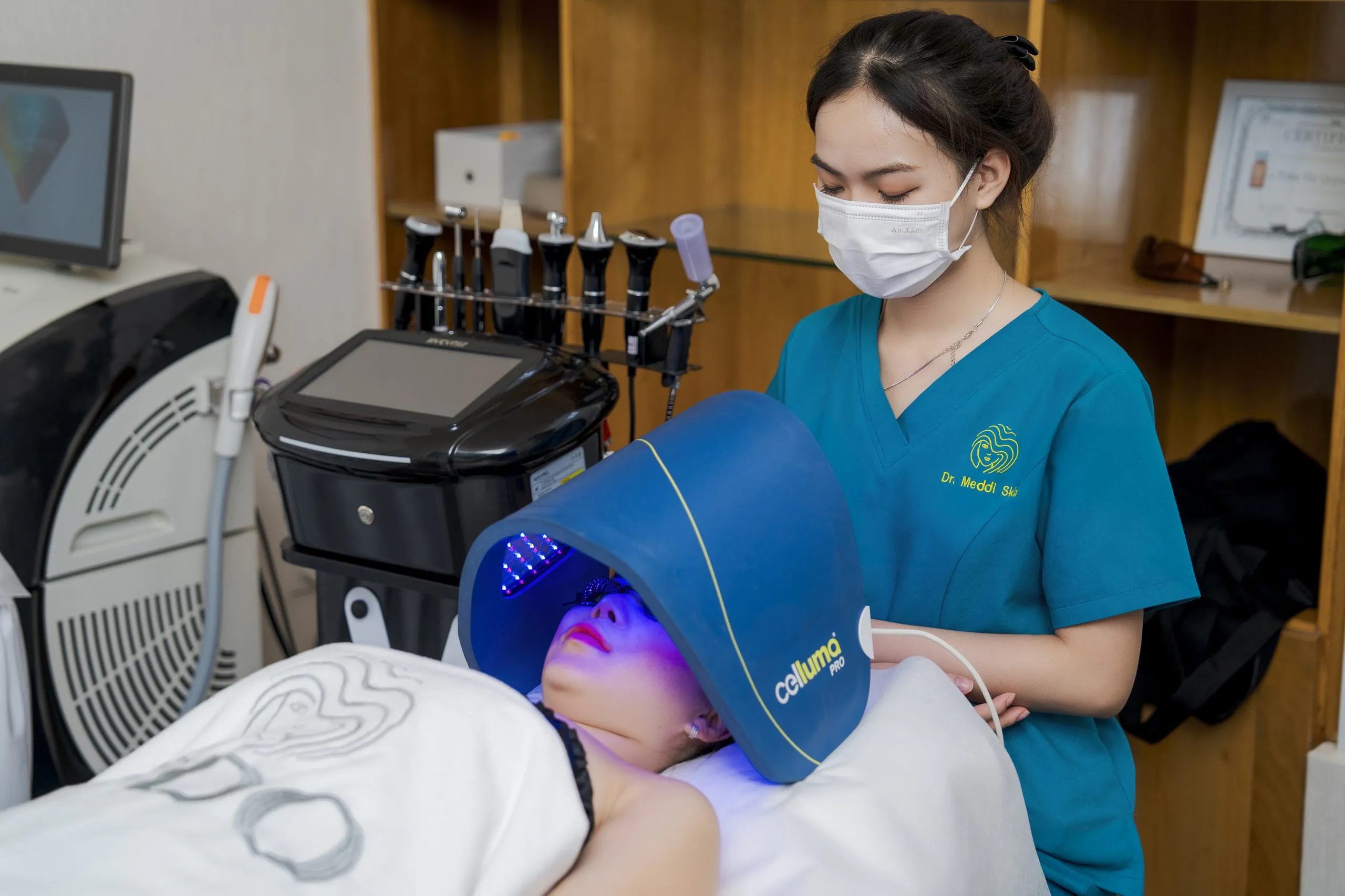
Celluma LED — the calming step after extraction
Low-energy red and near-infrared light is absorbed by skin tissue and used in the repair process, calming the treated area and reducing redness after an extraction visit. It creates no wound and removes no surface tissue. Indicated as the closing step of a session, or between sessions when skin needs extra recovery; the effect is cumulative, so keeping to schedule matters more than any single session. No downtime — makeup can go back on the same day. Cost: 330,000 VND per session.
The MA line — programs built for non-inflamed acne
MA is our internal designation for the programs built around hidden and non-inflamed acne; the number after it is a program code used for booking and billing, not a severity score. Each session is a complete sequence: cleansing, keratin softening, extraction, recovery and hydration. Indicated by degree of keratin build-up, oiliness and affected area, with the line and the number of sessions chosen after the skin analysis rather than sold as a fixed package. Sessions sit a few weeks apart, in step with the skin's renewal cycle. No meaningful downtime beyond mild same-day redness. Cost: 760,000 VND for MA1, 970,000 VND for MA1 Pro, 1,100,000 VND for MA2 — the hidden-acne program — 1,350,000 VND for MA1 Promax and 1,400,000 VND for MA3 where the skin needs intensive recovery.
Why choose this treatment
Treatments & pricing
100% of treatments are performed by dermatology specialists. Prices do not include 8% VAT. Contact us for a direct assessment and an exact quote based on your skin, severity and target area.
| Treatment | Price |
|---|---|
Celluma USA LED therapy for acne recovery and redness reduction | 330.000 VND |
Basic acne-extraction course | 390.000 VND |
Oily & acne-prone skin care program — clearing and brightening (MA1) | 760.000 VND |
Renewing regional peel | 790.000 VND |
Dermalogica peel for brighter, clearer, less-marked skin | 890.000 VND |
Premium combo — deep extraction + brightening complex | 910.000 VND |
Advanced oily-skin acne care program (MA1 Pro) | 970.000 VND |
Hidden-acne (closed comedone) clearing program (MA2) | 1.100.000 VND |
Dermalogica 3-Layer Peel | 1.100.000 VND |
Intensive oily-skin acne care program (MA1 Promax) | 1.350.000 VND |
Intensive acne-skin recovery program — tone and texture (MA3) | 1.400.000 VND |
Full-face renewing peel | 1.500.000 VND |
Extraction + skin-renewal combo with Aqua Hydro/Nano C hydration (TD1) | 1.610.000 VND |
5 steps, clinically led
Step 1: Skin analysis and multi-layer imaging — free
Imaging shows what the eye misses: how deep the comedones sit, how thick the horny layer is, where the skin produces the most oil, and whether any inflammation is starting. This step is free, including if you decide not to treat.
Step 2: Your dermatologist reads the results and builds the plan
You are shown what is driving the congestion on your own skin, then given a plan matched to that mechanism — which steps, in which order, roughly how many sessions, and an itemized quote before you agree to anything.
Step 3: Soften the horny layer and reopen the follicle
The skin is deep-cleansed, then a medical peel or an appropriate keratin-softening step is applied so the horny layer sheds evenly and the follicle drains again — the precondition for safe extraction.
Step 4: Medical extraction and same-session recovery
Comedones that have reached a safe depth are removed with sterile instruments along the follicle axis; lesions that are not ready are left for the next visit. The skin is then hydrated, calmed and barrier-repaired in the same session so it does not rebound with excess oil.
Step 5: Follow-up on the skin's cycle, plan adjustment, then maintenance
Standardized before-and-after photos are compared, response is assessed area by area, and intensity or interval is adjusted. Once texture has settled, the course moves into maintenance with progressively wider spacing.
Still have questions?
How long does it take to get rid of closed comedones?
Do closed comedones go away on their own?
Should you pop closed comedones?
What is the difference between closed comedones and whiteheads?
Why am I breaking out more after starting acne treatment?
Can a chemical peel clear closed comedones?
How much does hidden acne treatment cost in Ho Chi Minh City?
Shine with confidence in clear, radiant skin
Start your skin story.
Schedule your diagnostic session. Our doctors will map your unique skin biology to build a lifelong protocol for health.