
Hair Loss Treatment for Women at WeDo Skin Clinic Ho Chi Minh City
Female-pattern and postpartum hair loss assessed by a dermatologist in Ho Chi Minh City. Free scalp exam; laser from 3,900,000 VND, PRP from 4,900,000 VND.
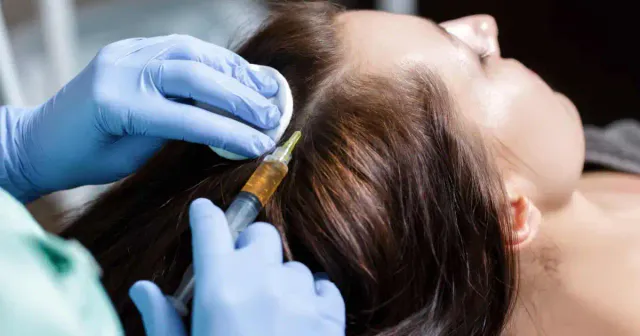
At WeDo Skin Clinic, a dermatologist examines and scopes your scalp free of charge to separate the two before any treatment is discussed; where treatment is indicated, laser hair regrowth starts at 3,900,000 VND per session (no needles, no blood draw, no medication) and PRP or mesotherapy at 4,900,000 VND per session.
Both WeDo clinics — District 1 and District 2 — consult in English, and the first visit costs nothing. If you want the underlying method pages, PRP for hair loss is the parent page for this service group; otherwise you can book a free scalp assessment and decide afterward.
## You only pay when treatment is indicated
How it works

Female-pattern hair loss and postpartum shedding: how to tell them apart
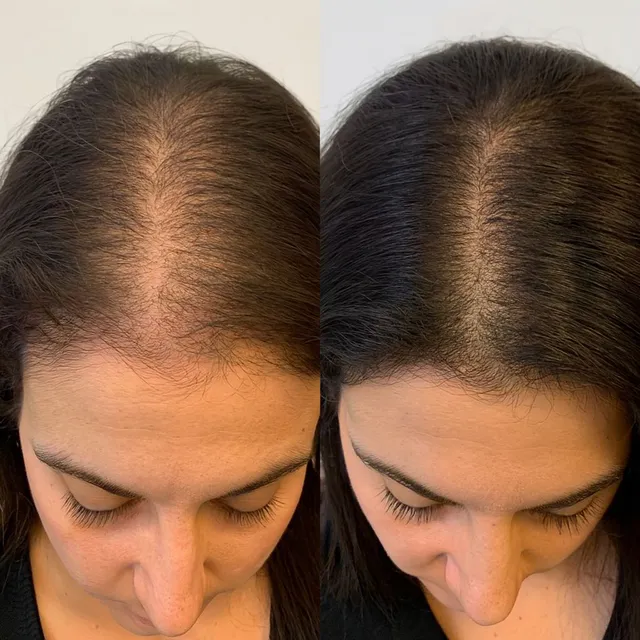
Female-pattern hair loss is a slow, patterned thinning. Daily shedding may look entirely normal, but the parting widens year on year, regrowth comes back finer and lighter than the hair it replaces, and the frontal hairline at the temples usually stays intact. Postpartum shedding — telogen effluvium — is diffuse across the whole scalp. Hormonal change after birth pushes a large share of follicles into the resting phase at the same time, and a few months later they release at the same time. You lose a striking amount of hair, but the parting and the density at the roots are largely unchanged. It is the hair cycle reacting, not follicles being lost.

What causes hair loss in women? What a dermatologist checks first
– Iron deficiency or low iron stores, common after birth and after any period of blood loss. – Thyroid disease, which can drive prolonged diffuse shedding with few other obvious symptoms. – Hormonal disorders, particularly alongside menstrual changes or unusual hair growth elsewhere. – The months after a serious illness, surgery, or rapid weight loss. – Sustained stress and sleep deprivation, effectively the default state of the first year after a birth. – Conditions of the scalp itself: inflammation, fungal infection, scaling, or damage from styling.
How long does postpartum hair loss last?
Usually 6–12 months from the point shedding begins, and for most of that time no procedure is needed. The typical course runs through the following milestones, though the pace varies from person to person: – Months 0–2 after birth: usually little shedding; hair still feels as thick as it did in late pregnancy. – Months 2–4: shedding becomes obvious. This is the point at which most mothers start searching for answers. – Months 4–6: the peak. At the same time, new short hairs typically appear along the frontal hairline and temples – Months 6–12: shedding tapers and density recovers toward its pre-pregnancy level. – After 12 months: if shedding is still heavy, or worsening, that is no longer a typical course and should be examined.
When should hair loss in a woman be examined?
– Shedding is still heavy past the 12-month mark after birth. – The shedding is worsening over time rather than tapering. – The parting looks visibly wider than it does in older photographs. – A patch of loss appears with a clear border - localized rather than diffuse. – The scalp is itchy, red, scaly, or painful. – Regrowth in one area is markedly finer and weaker than the surrounding hair.
Hair loss treatment while breastfeeding: what can and cannot be done
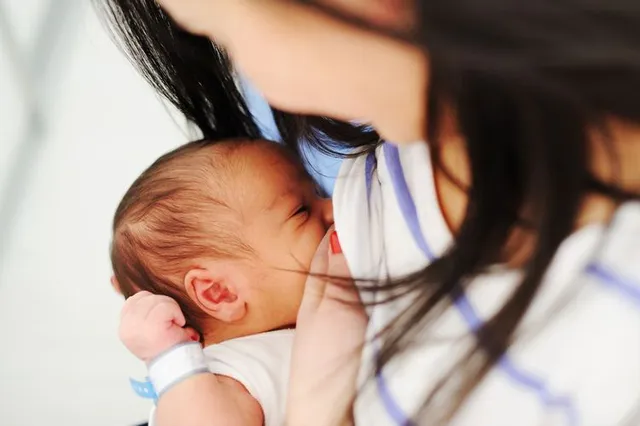
During pregnancy and breastfeeding, WeDo prioritizes monitoring and addressing the underlying cause first, and does not perform scalp procedures in that window; your dermatologist assesses each patient individually and decides when starting is appropriate. That is the complete answer to the question almost every mother asks in the first minute of the consultation.

The methods WeDo uses when treatment is indicated
Laser hair regrowth uses fine laser micro-points to create controlled micro-injuries on the scalp, triggering a healing response around the follicles and improving circulation in the treated field.mFrom 3,900,000 VND per session depending on how much of the scalp is treated. PRP uses platelet-rich plasma separated from your own blood to bring growth factors to the tissue around the follicles, supporting weakened follicles back toward the growth phase. 4,900,000 VND per session, or 7,900,000 VND for the Pro Kit. Because the material is your own blood, allergy is essentially a non-issue. Mesotherapy delivers follicle-nourishing solution into the dermis through very fine needles, spread across many points rather than concentrated in one. It suits a dry, depleted or fragile scalp, and it is often used to support recovery between other sessions. 4,900,000 VND per session.
Who should not start treatment yet
– Anyone pregnant or breastfeeding: monitoring and treating the underlying cause come first, and your dermatologist decides when starting is appropriate. – Anyone with an inflamed or infected scalp, an open wound, or a scalp condition currently flaring. – Anyone in an acute illness, or with an underlying condition that is not yet stable. – Anyone whose internal causes have not been reviewed while the history points toward one. – Anyone whose follicles have stopped growing entirely
Why choose this treatment
Treatments & pricing
100% of treatments are performed by dermatology specialists. Prices do not include 8% VAT. Contact us for a direct assessment and an exact quote based on your skin, severity and target area.
| Treatment | Price |
|---|---|
Fractional CO2 laser hair regrowth (Alma Pixel) — one-third scalp | 3.900.000 VND |
Fractional CO2 laser hair regrowth — full scalp (K-FCO2) | 4.800.000 VND |
PRP Hair Regeneration Therapy | 4.900.000 VND |
PRP Hair Regeneration Therapy - Pro Kit | 7.900.000 VND |
Mesotherapy to nourish and stimulate hair growth | 4.900.000 VND |
Scalp-nourishing vitamin injection | 2.000.000 VND |
6 steps, clinically led
Step 1: Consultation, medical history and scalp scope
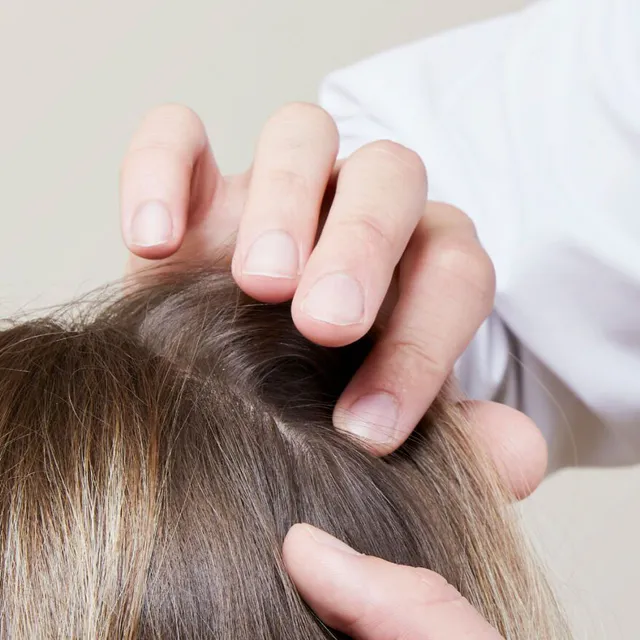
Your dermatologist asks about the date of delivery, medical history, anything you are taking on prescription, and your diet and sleep over recent months, then scopes the scalp to record hair density, shaft diameter and scalp condition region by region.
Step 2: Classifying the loss and reviewing internal causes
Diffuse postpartum shedding is separated from female-pattern loss, cases showing both are noted, and further checks or coordination with another specialty are recommended where the history points to an internal cause.
Step 3: Deciding the direction — monitor or treat
This step can legitimately end with nothing to do, plus a specific follow-up date for comparing scope images. It is the most common outcome for mothers inside the first 12 months after birth.
Step 4: Building a personalized protocol where treatment is indicated
Where treatment is indicated, your dermatologist selects and combines methods according to the pattern of loss and the state of the scalp, estimates the number of sessions, and quotes the expected cost before you decide.
Step 5: The procedure at the clinic
The scalp is cleansed and disinfected, topical anesthetic is applied as the chosen method requires, and your dermatologist performs the procedure.
Step 6: Aftercare, baseline photography and review appointment
You are taken through aftercare for the days that follow, scope photographs are taken as a baseline, and a review is scheduled so progress is compared at fixed intervals rather than judged day to day.
Make results last
Caring for your hair and scalp during a heavy shed
Wash gently, but do not skip washing. Many mothers stretch the interval between washes because every wash seems to cost them hair, when in fact the hairs that come out in the shower had already finished their cycle and would have released anyway — and an oily, congested scalp only makes the situation less comfortable.
Avoid tight ties and frequent high buns: continuous tension on the roots breaks hair exactly where it is weakest. Cut back on heat and chemical styling for now, and only brush once the hair is dry, since wet hair is when the shaft snaps most easily.
If you are pregnant or breastfeeding, this is also the moment to review the ingredients in everything you use daily, hair and scalp products included — what is and isn’t done during pregnancy is a useful starting point.
Nutrition and sleep — the part most often skipped after a birth
Hair follicles are among the most energy-hungry tissues in the body, and among the first the body deprioritizes when supply runs short. Enough protein, enough total energy and enough water across the day influence how quickly you recover more than most of what you put on your scalp.
Do not start any supplement on your own while breastfeeding. Anything taken internally should be on a doctor’s instruction, once it has been established what you are actually short of — supplementing on hearsay neither fixes the cause nor helps anyone find it.
Sleep is the hardest variable in the first year, and it is a real one. Catch it up wherever you can; that sits inside the plan rather than alongside it as a pleasantry.
After each scalp procedure
For the first 24–48 hours: no hair washing, no tight hats, and no vigorous rubbing of the scalp. The treated area needs to be left alone during that window.
For the week that follows: no coloring, perming or straightening, and keep harsh direct sun off the scalp, particularly along the parting. If redness, itching or discomfort lasts longer than expected, tell the clinic rather than treating it yourself.
Tracking results properly
Judge progress from scope photographs taken at fixed intervals, roughly every 8–12 weeks, not from how much hair is on your pillow each morning. Daily shed counts swing with the week, with your sleep and even with how you washed — they support almost no conclusion.
If you are still weighing up whether to be seen at all, where to have hair loss examined in Ho Chi Minh City sets out what an appointment involves and what to bring.
Still have questions?
How long does postpartum hair loss last?
Does postpartum hair grow back?
What causes hair loss in women?
What is the best hair loss treatment for women?
Can I have hair loss treatment while breastfeeding?
How is female-pattern hair loss different from postpartum shedding?
How much does hair loss treatment for women cost in Ho Chi Minh City?
Shine with confidence in clear, radiant skin
Start your skin story.
Schedule your diagnostic session. Our doctors will map your unique skin biology to build a lifelong protocol for health.