WeDo Skin Clinic
Consult a dermatologist

Personalized plans — effective & safe

Book a consultation
Hotline: (+84)-898898875
Zalo chatCall nowMessengerLocation
Psoriasis Treatment in Ho Chi Minh City: Plaque, Guttate, Inverse, Nail
Services & Treatments

Psoriasis Treatment in Ho Chi Minh City: Plaque, Guttate, Inverse, Nail

Psoriasis explained: plaque, guttate, inverse and nail types, flare triggers and the warning signs to act on. Free dermatologist exam in Ho Chi Minh City.

Medically reviewed by Dr Quynh Trang, Dermatologist (HCMC) · Updated August 1, 2026

Psoriasis is not contagious. It is a chronic inflammatory condition driven by an overactive immune system, which speeds up skin-cell turnover until the cells pile up as raised red plaques under a silvery-white scale — not a fungus, not a hygiene problem, and not something anyone can catch from you through touch, shared towels or a shared pool. There is no permanent cure, but psoriasis is controllable: the goal of treatment is to clear the lesions during a flare and to lengthen the settled stretches in between. The dermatologist examination and skin analysis at WeDo Skin Clinic are free — including when all you want is to know whether the scaly patch you have been looking at is psoriasis, eczema or a fungal infection; your treatment plan and its cost are quoted after that examination, because psoriasis does not come in a pre-packaged course. Treatment usually runs on two tracks at once: medication prescribed by your doctor for the flare, and the daily side — consistent moisturizing plus identifying your own triggers — that makes flares less frequent and less severe.

Psoriasis makes people cover up, skip the pool and brace for a second look from strangers; and the feeling of treating something forever without getting anywhere is real, not imagined. If you bought something over the counter before coming in, or tried a remedy someone recommended, say so plainly — your dermatologist needs that information to read the skin in front of her, not to judge it.

Our clinics are in District 1 and District 2, and consultations are held in English. This page is specifically about psoriasis; for the wider picture of what we treat, start from treatment of skin diseases at WeDo. If your patches are more dry than scaly, intensely itchy and vaguely bordered, the likelier picture is eczema and dermatitis rather than psoriasis.

The technology

How it works

What is psoriasis, and why does the skin build up silvery scale?

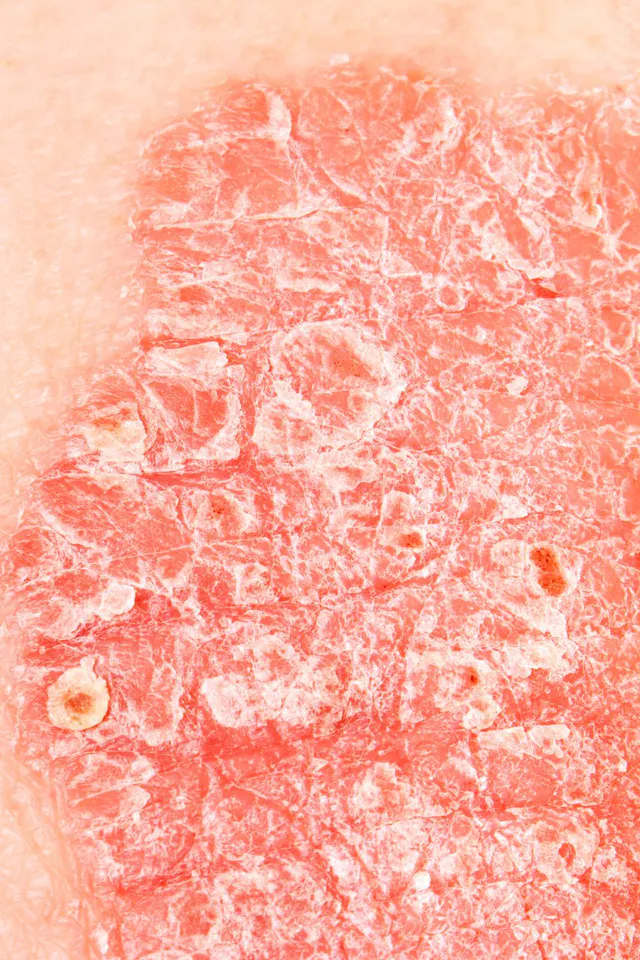
In skin that is behaving normally, a cell takes roughly four weeks to travel from the bottom layer to the surface, where it sheds without anyone noticing. In psoriasis, an overactive immune response shortens that journey to a few days. Cells arrive at the surface before they have matured, they do not shed in time, and they accumulate as a thick silvery-white scale; underneath sits red skin, red because the vessels are dilated and the inflammation is ongoing. That is the whole mechanism, and it is a closed loop rather than a surface accident. Understanding the loop answers a question we get constantly: why picking or scraping the scale off never makes the disease milder. The production happens underneath, so removing the scale only removes what is already dead. Worse, every act of picking is an injury to the skin — and injured skin is exactly where psoriasis likes to appear next. A word on names, once, so you can stop reconciling them. "Psoriasis" is the international medical term for this condition. It is not the same thing as eczema, even though both are red, both scale and both come and go: eczema is inflammation on a weakened skin barrier, while psoriasis is accelerated cell turnover driven by the immune system. The two are treated along different lines, which is why the label matters more here than it usually does. And to say the most common misconception plainly, because it is also the one people are most embarrassed to ask about: psoriasis is not contagious, it is not a fungus, and it is not the result of poor hygiene.
Common types of psoriasis and where they appear

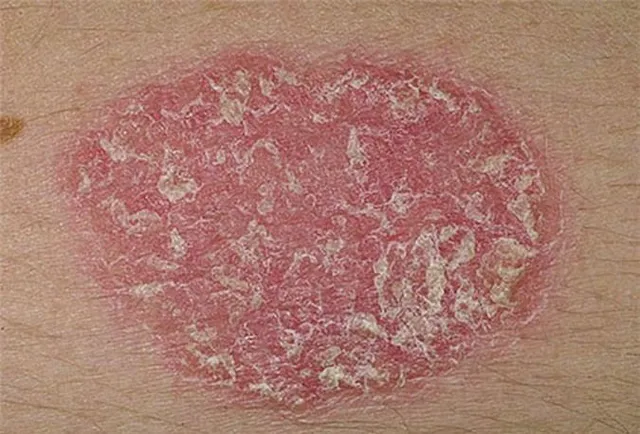
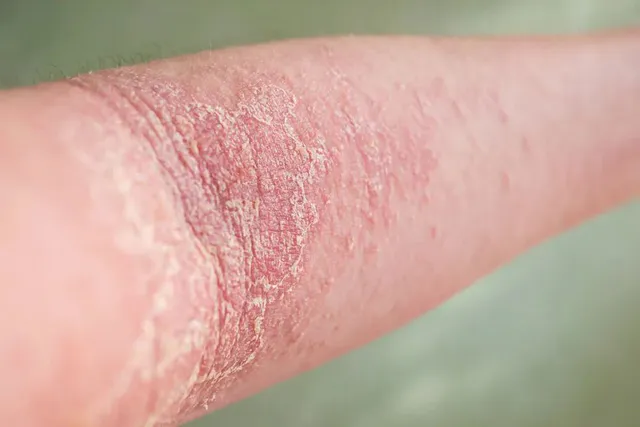
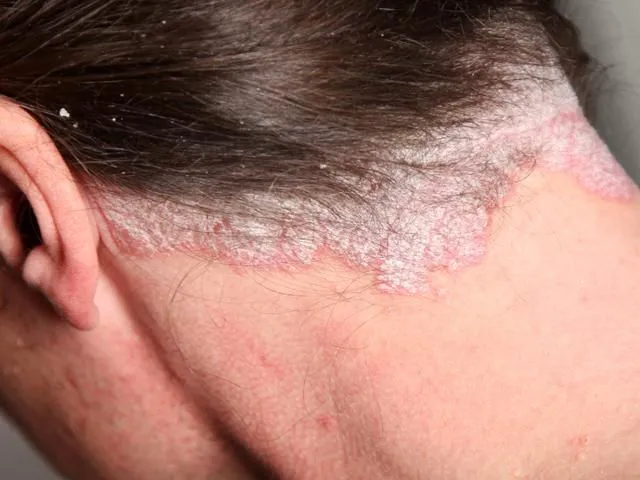
Plaque psoriasis is the most common form, and it is the picture most people have in mind: sharply bordered red plaques under a silvery scale, favoring the elbows, knees, lower back and scalp. The lesions are often symmetrical, and they stay in the same place for weeks or months rather than moving around. Scalp psoriasis deserves its own paragraph, because it is both the most frequent site and the most frequently misread one. The scale sits thick and adherent on the scalp and can extend past the hairline onto the forehead, the nape or behind the ears — which is the useful distinguishing detail, since ordinary dandruff is fine, thin, evenly distributed flaking that stops at the hairline, while a psoriatic plaque is thick, sharply bordered and does not respect that boundary. The two can also coexist on one head, which is why telling them apart belongs in a consultation rather than in front of a bathroom mirror. Guttate psoriasis shows up as many small, drop-shaped lesions scattered across the trunk and limbs, more often in younger people. Its most memorable feature is the context in which it starts: it commonly follows an upper respiratory infection. That is the explanation behind a story we hear often at first visits — "it appeared all over me a couple of weeks after a sore throat." Inverse psoriasis occupies the body folds: armpits, groin, under the breasts, the genital area. Because the skin there stays moist and rubs against itself, the lesions tend to look smooth, shiny and red with little or no visible scale — nothing like the classic image. The practical consequence is that this type is regularly mistaken for a fungal infection or a rash and treated in the wrong direction for a long time. If your lesions are in those areas, tell your dermatologist; there is nothing to be awkward about, and staying quiet only extends the detour. Nail psoriasis shows as pitting, as though the nail had been pricked with a pin, along with thickening, discoloration or the nail lifting away from its bed. Many people are treated for a nail fungus for months before anyone looks carefully at the surrounding skin. One thing worth remembering: nail involvement is among the features associated with a higher risk of psoriatic arthritis, so if your nails have changed and your joints ache, do not wait — that combination is a good reason to be seen soon. On sites and severity in general: elbows, knees, scalp, lower back, hands and feet, face and nails can all be affected, and one person can have more than one type at once. Most cases are mild to moderate, meaning the lesions are limited to a few areas and respond to treatment applied to the skin. But mild on the skin is not always mild in life, and how much this affects your sleep, your work and what you feel able to wear is information your dermatologist needs to hear.
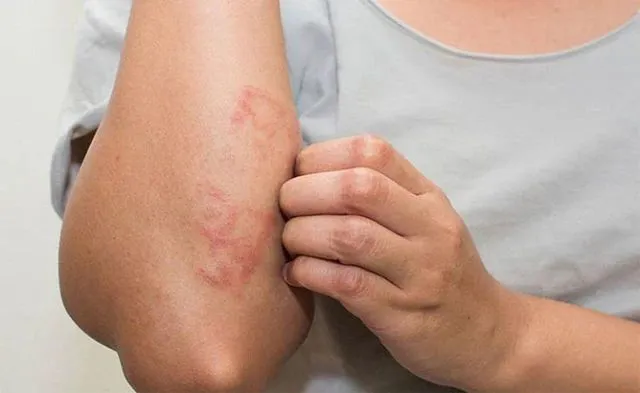
How is psoriasis different from eczema, fungal infection and dandruff?

This section exists to explain why those three get confused with psoriasis — not so you can match your own patches against a list at home. What they share is redness and scale, and skin has only a handful of ways to signal that something is wrong. Versus eczema and atopic dermatitis: both are red, both itch and both relapse. The difference is mechanistic. Psoriasis is accelerated cell turnover driven by immune dysregulation, so the scale is thick and silvery, the plaque has a sharp border, and it favors the outer surfaces of elbows and knees. Eczema is inflammation on an already weak skin barrier, so the skin is drier, the scaling is finer, the borders are vaguer, and it favors the inside of the elbows and the backs of the knees. The two are treated along different lines, which is why naming it correctly is not a semantic exercise. Versus a fungal infection: fungal patches are also red and scaly, but they typically spread in a ring with an active raised edge and a paler center. This is the most expensive confusion in the group, because the two conditions respond to entirely different treatment, and going in the wrong direction can cost months with the lesions still exactly where they were. Versus dandruff and seborrheic dermatitis of the scalp: as described above, dandruff is fine, thin and evenly spread, while a psoriatic plaque is thick and sharply bordered. In practice both can be present on the same scalp, and separating them is a clinical judgment your dermatologist makes in person. The point of these differences is to explain why diagnosing yourself from photographs online is a bad idea. In photographs all four can look nearly identical. Only an in-person examination with magnified skin analysis settles it, and in unclear cases your dermatologist will arrange further assessment before prescribing anything.

Why does psoriasis keep coming back? Flare cycles and triggers

Psoriasis moves in episodes. There are stretches when lesions flare, stretches when they settle until the skin is nearly clear, and then another flare. A relapse does not mean the treatment failed — it is the nature of a chronic inflammatory disease, and the realistic goal is to make flares less frequent, milder and shorter. Worth saying at the outset, because otherwise people abandon treatment that is actually working. What decides whether the next flare arrives sooner or later is usually a set of triggers, and they are fairly ordinary. Stress and short sleep are the triggers patients name most often, and they close a loop of their own: worse skin is stressful, and stress worsens the skin. Infections — a throat infection in particular — can set off a flare, most visibly the guttate type. Skin injury is the most overlooked trigger of all: a scratch, a cut, a tattoo, aggressive shaving or scratching, tight clothing rubbing, and above all picking the scale off can all produce new lesions exactly where the skin was damaged. The phenomenon has a name in the literature, but all you need to carry is this: psoriatic skin does not tolerate being hurt. Climate and environment play a part too. Cold, dry air dries the skin faster; in Ho Chi Minh City the equivalent is moving in and out of air conditioning a dozen times a day, plus chlorinated pool water. Alcohol and tobacco make the disease harder to control in many people. Finally, some medications taken for other conditions can affect psoriasis, and so can stopping a treatment abruptly on your own — both are conversations to have with your doctor rather than decisions to make and observe. If you have recently moved to Vietnam, expect your psoriasis to behave differently for a while. This is one of the most common reasons long-stay foreigners come to see us. The climate is hot and humid instead of cold and dry, you spend the day alternating between that humidity and heavy air conditioning, the water and the household products are different, you are getting more sun than you used to, and the stress profile of a relocation is its own factor. On top of that, whatever you were prescribed at home has often run out or is not available here in the same form. None of that means something has gone medically wrong; it does mean the routine that used to hold your skin steady deserves reviewing rather than repeating. Bring your previous prescriptions, packaging and any records with you to the appointment — it is the single most useful thing you can put in front of a new dermatologist. Finally, triggers are deeply individual. Two people with the same diagnosis can have two entirely different lists, and no amount of reading produces yours. It gets reconstructed during the consultation, from your history, your work, your habits and what is happening in your life at this particular stretch.

When should you see a dermatologist right away?

Come in promptly if you have joint pain, swelling or stiffness — particularly morning stiffness that lasts — or an entire finger or toe that swells. This is the most important item on the list: some people with psoriasis develop psoriatic arthritis, and joint damage that is missed may not be recoverable. Joint symptoms in someone with psoriasis are always a reason to be seen, even when the skin looks settled. Come in right away if the lesions spread rapidly over most of the body, or if your skin turns widely, intensely red with chills or marked fatigue. Come in right away if small pustules appear in clusters on red skin, especially alongside a fever. Come in if the lesions involve the face, the body folds, the genital area or the nails. Come in if the itch is costing you sleep. Come in if a lesion weeps, forms yellow crusts, becomes increasingly swollen, hot and painful, or comes with a fever — those suggest secondary infection. Come in if the skin has not improved after a prescribed course. And come in early if you are pregnant, living with another condition, taking immunosuppressive medication, or have recently stopped a treatment on your own. This list exists so that you get seen — not so that you can diagnose or manage yourself at home. So what does a psoriasis plan actually look like? Your dermatologist examines the skin, takes a full history including joint symptoms, and establishes the type, the sites involved and how much it is affecting your daily life. The flare is brought under control with medication prescribed by your doctor, chosen for you and for the specific areas involved. Running alongside it is the part you do daily at home: consistent moisturizing and reducing your own triggers. Then comes a review appointment, so the response can be assessed and the medication adjusted or stopped at the right moment rather than continued indefinitely with nobody watching. And if your case goes beyond what a clinic can appropriately treat, your dermatologist will say so plainly and point you to the right place — that is part of being examined properly, not a refusal.

Advantages

Why choose this treatment

A dermatologist personally examines and analyzes your skin and establishes which type of psoriasis you have before prescribing anything.
The examination and skin analysis are free, even if all you want is to find out what the scaly patch actually is.
Psoriasis is distinguished from eczema and fungal infection during the visit itself, instead of months spent treating the wrong condition.
Treatment plans are built around your type, your affected sites, your severity and your own trigger list.
Scheduled review visits, so medication is adjusted or stopped at the right time rather than used long-term without supervision.
Your dermatologist says so plainly when a case needs to be followed at a more specialized level.
Two clinics, in District 1 and District 2, with consultations in English.
Pricing

Treatments & pricing

100% of treatments are performed by dermatology specialists. Prices do not include 8% VAT. Contact us for a direct assessment and an exact quote based on your skin, severity and target area.

Skin examination and dermatologist consultation for psoriasisYour treatment plan and its cost are quoted after the examination
FREE

See the full price list

Treatment process

5 steps, clinically led

1

Step 1: History, including your joints

Your dermatologist asks about onset, how each flare has behaved, family history, your occupation and everything you are currently taking — and asks specifically about joint pain, swelling and morning stiffness.

2

Step 2: Full-skin examination and analysis

The examination covers the sites most often missed — the scalp, the body folds and the nails — because those three frequently decide which type of psoriasis you have and how extensive it is.

3

Step 3: Plan discussion and a specific quote

Your dermatologist explains your type, states plainly that the goal is control rather than a permanent cure, describes the steps involved, and quotes the cost specifically before you decide anything.

4

Step 4: Treatment

The flare is brought under control with medication prescribed by your doctor, running alongside the daily moisturizing and trigger-reduction work you carry out at home.

5

Step 5: Review, maintenance and joint monitoring

Your dermatologist assesses the response, adjusts or stops medication at the right point, sets a maintenance plan for the settled periods, and keeps watching for joint symptoms.

Aftercare

Make results last

Daily care for psoriatic skin: moisturizing, washing and what not to do

For psoriasis, moisturizing is not a beauty step — it is part of the treatment. Use something richer than you think you need, apply it several times a day, and apply it while the skin is still slightly damp after washing, because those first few minutes are when an emollient holds water in most effectively. Softer scale also means less cracking, less itching and far less temptation to pick.

Wash in comfortably warm water rather than hot, and keep it short. Use a gentle, fragrance-free cleanser, avoid harsh bar soaps, and never scrub a plaque with a rough cloth or a pumice stone. Wash your hair with your fingertips, not your nails.

And the most important instruction in this section: do not pick, peel or scrape the scale, however loose and however irritating it gets. Damaged skin is precisely where psoriasis appears next, so every scale you remove is paid for with a new lesion in the same spot. Keep your nails short, wear loose cotton, and when the itch arrives, cool the area rather than scratching it.

This page deliberately names no ingredients and no specific products, because the right choice depends on your type, your sites and your severity. If you want the principles behind choosing for easily irritated skin, read how to identify and care for sensitive skin, our list of ingredients sensitive skin should avoid and these sensitive skin care tips for the calm stretches. If a new product has left the skin acutely irritated, work through steps to deal with skin irritation before putting anything else on the area.

WeDo also offers separate skincare services with their own price lists, such as deep hydration recovery. That is not a treatment for psoriasis and is not part of the plan described on this page; whether it suits you, and when, is your dermatologist’s decision after examining your skin.

Reducing your triggers: what actually makes a difference

Start with a flare diary. Every time the skin turns, write a few lines: the date, the areas involved, what you had just been doing, whether you have had a sore throat or any infection recently, the weather, and how you have been sleeping. After three or four flares the overlaps start to surface on their own — and they are usually not what you first suspected. Bring the diary to your appointment; it shortens the search for a cause dramatically, because your dermatologist is working from your real data rather than guessing.

The rest is simple and durable: deal with throat infections early instead of letting them drag on; sleep enough and find a way to unload stress that actually works for you; go easier on alcohol and tobacco; protect your skin from scrapes, avoid clothing that rubs, and think twice before a tattoo. If you sit in air conditioning all day, moisturize more than you otherwise would. And do not stop or switch a prescribed treatment on your own, even when the skin has cleared — that is one of the most common causes of a flare we see.

On diet: there is no restriction list that applies to everyone, so if you suspect something, note it down and discuss it rather than cutting out food groups on your own.

If you have arrived recently and are still working out how healthcare here fits together, our guides on seeing a dermatologist in Vietnam and skin treatment for foreigners in Vietnam cover the practical side — booking, what a first visit involves and what to bring.

Living with a chronic condition: when to come back in

A relapse does not mean the treatment failed. With psoriasis, a new flare usually signals two things worth rechecking: which trigger has come back into your life, and whether the daily care quietly stopped once the skin looked good again.

Book a review if joint symptoms appear, if the lesions spread quickly, if pustules appear with a fever, if there are signs of secondary infection, if the itch is costing you sleep, or if the skin has not improved after a prescribed course. Do not simply repeat an old prescription for a new flare without having it looked at — this episode’s type and severity may not match the last one’s.

If you are still weighing up which condition you actually have, two of our other pages go deeper. For the eczema side, our article on atopic dermatitis covers that entity in more detail than this page does. And if the real problem is chronic facial redness that flushes with heat or spicy food and carries no scale, the picture points toward rosacea instead: read understanding rosacea.

How a visit and a course of treatment are organized at WeDo is set out on our treatment process page, and the costs of our other services are listed in the full price list. Your own examination and skin analysis, though, are free: book a free exam at our District 1 or District 2 clinic — including if all you want is a name for the patch you have been looking at.

FAQ

Still have questions?

Is psoriasis contagious?
No. Psoriasis does not pass from person to person through skin contact, hugging, shaking hands, sharing clothes or towels, or swimming together; it is a chronic inflammatory condition driven by an overactive immune response, not an infection and not a fungus. It does run in families, so more than one person in a household can have it — that is inherited predisposition, not transmission.
Can psoriasis be cured?
There is no permanent cure, but psoriasis is controllable: with the right treatment the lesions can clear almost completely during a flare, and the next goal is to lengthen the settled periods in between. The disease can also quieten down on its own for a while and then return, which is its natural course rather than a sign it has gone. Your dermatologist will set out realistic expectations for your specific case during the consultation.
Does psoriasis itch?
Yes. Many people with psoriasis itch, the intensity varies a great deal between individuals and between flares, and for some it is enough to disturb sleep — the belief that psoriasis does not itch is simply inaccurate. If the itch is costing you sleep or you are scratching until the skin breaks, come in, because damaged skin can grow new lesions in the same place.
Is psoriasis dangerous?
Psoriasis is not contagious and most cases are mild to moderate, but it is a chronic condition that needs following rather than a purely cosmetic concern. Some people also develop psoriatic arthritis, which shows as joint pain, swelling or stiffness — particularly morning stiffness that lasts — and it needs picking up early. If you have joint symptoms, or lesions spreading rapidly, widespread intense redness, or pustules with a fever, be seen right away rather than waiting.
What is the difference between psoriasis and eczema?
Psoriasis is accelerated skin-cell turnover driven by immune dysregulation, producing sharply bordered red plaques under thick silvery scale, typically on the elbows, knees, scalp and lower back. Eczema is inflammation on a weakened skin barrier, so it is drier, itchier, more finely scaled and more vaguely bordered, and it favors the body's flexural creases. The two are treated along different lines, which is why the distinction needs an in-person examination rather than a comparison against photographs.
Should I use an over-the-counter cream on psoriasis?
Better not to. Over-the-counter products work in quite different ways and carry different indications; some are only meant for limited periods under supervision, and using the wrong one, using one on thin skin, or using one for too long can worsen the damage, mask signs of infection, or trigger a strong flare when it is stopped abruptly. Psoriasis is also easily confused with fungal infection and eczema, so treating on a guess commonly costs months — have a dermatologist examine the skin and prescribe for your type.
Is psoriasis an autoimmune disease?
Psoriasis is an immune-mediated condition: the immune system behaves overactively toward the person's own skin, which speeds up cell turnover and produces the plaques. It is not an allergy, not an infection and not something caused by hygiene. That immune basis is also why it is chronic, why it comes in flares, and why treatment aims at control rather than a one-off fix.
Do I need a referral to see a dermatologist in Ho Chi Minh City?
No. You can book directly with WeDo — no referral and no prior GP visit is required, and consultations are held in English. If you are claiming on international insurance, tell us at the visit and we will issue an itemized receipt for your provider.
How much does psoriasis treatment cost at WeDo?
The dermatologist examination and skin analysis are free. Because psoriasis varies so much by type, affected sites and severity, we do not list a single price for "psoriasis treatment": your dermatologist examines the skin, establishes the type and extent, and quotes the plan and its cost after that visit.

Shine with confidence in clear, radiant skin

Start your skin story.

Schedule your diagnostic session. Our doctors will map your unique skin biology to build a lifelong protocol for health.

11 TRẦN DOÃN KHANH, QUẬN 1
17 THÁI THUẬN, QUẬN 2

Include your country code, e.g. +84-857466767