
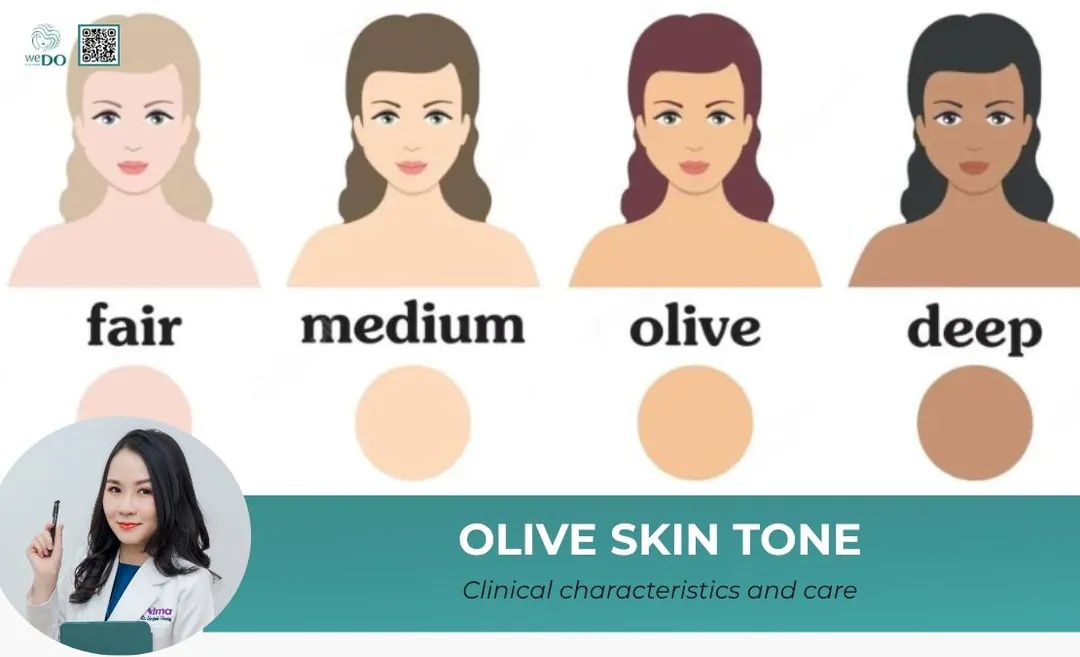
Olive skin tone is often misunderstood, making it difficult to identify and care for properly. Learn what defines an olive undertone, its key characteristics, skincare considerations, and how to maintain healthier skin with evidence-based recommendations.
What is an olive skin tone?
An olive skin tone refers to a skin undertone characterized by subtle green, golden, or grayish hues beneath the skin’s surface. Unlike skin depth—which ranges from fair to deep—undertones remain relatively constant regardless of sun exposure or seasonal changes. As a result, people with an olive undertone can have fair, light, medium, tan, or deep complexions while sharing similar underlying pigmentation.
It is important to distinguish skin tone from undertone. In dermatology, skin tone generally describes the visible depth of pigmentation, whereas undertone refers to the underlying hue that influences how skin appears and how colors interact with it. Although the term olive skin tone is widely used in cosmetics and beauty, it is not an official dermatological classification like the Fitzpatrick Skin Phototype, which categorizes skin based on its response to ultraviolet (UV) radiation rather than its undertone. This distinction helps explain why two individuals with similar skin depth may respond differently to makeup shades or color palettes.

Characteristics of an Olive Skin Tone
Recognizing an olive undertone is often more complex than identifying whether the skin is simply warm or cool. Because olive undertones combine yellow pigments with subtle green, gray, or muted hues, they may appear different under various lighting conditions and are frequently mistaken for warm or neutral skin. Rather than relying on a single characteristic, dermatologists and professional makeup artists recommend evaluating several visual and practical indicators together.
Visible undertone characteristics
The most recognizable feature of olive skin is the absence of obvious pink or rosy undertones. Instead, the complexion often carries muted golden, greenish, or slightly gray hues beneath the surface. These characteristics are especially noticeable around the neck, jawline, and chest, where redness is less likely to interfere with undertone assessment.
Importantly, an olive undertone is not limited to medium or tan complexions. Fair olive, light olive, medium olive, and deep olive complexions all exist, making skin depth an unreliable indicator of undertone.

Response to sun exposure
Many individuals with olive undertones belong to Fitzpatrick Skin Phototypes III–V, meaning they generally tan more easily than they burn. However, this should not be interpreted as natural resistance to sun damage. Ultraviolet radiation can still induce photoaging, pigmentation disorders, and skin cancer regardless of undertone.
Because tanning tendency varies widely between individuals, clinicians do not recommend using sun response alone to determine undertones.

Foundation matching challenges
One of the most practical indicators of an olive undertone is difficulty finding an accurate foundation shade. Products formulated with predominantly pink, peach, or strongly yellow bases may oxidize or appear unnaturally orange after application. This occurs because conventional shade systems often overlook the subtle green or muted pigments present in olive complexions.
Professional makeup artists therefore recommend assessing foundation along both depth and undertone, rather than relying solely on labels such as “warm” or “neutral.” Testing shades along the jawline in natural daylight remains one of the most reliable approaches.
Common misconceptions
Several popular methods for identifying olive undertones should be interpreted with caution.
The “vein test,” for example, suggests that green veins indicate warm or olive undertones, while blue veins indicate cool undertones. However, dermatology literature does not recognize vein color as a validated diagnostic method because vein appearance is influenced by skin thickness, vessel depth, and lighting conditions.
Similarly, jewelry tests—such as whether gold or silver looks better—may provide aesthetic guidance but should not be considered clinical evidence of undertone. Accurate identification is best achieved by evaluating multiple characteristics together rather than relying on any single observation.
Skincare considerations for olive skin
Having an olive undertone does not determine whether the skin is oily, dry, combination, or sensitive. Consequently, skincare recommendations should always be based on skin type and specific skin concerns, rather than undertone alone. Nevertheless, individuals with olive complexions may share several clinical considerations related to pigmentation and photoprotection.
Prioritize skin concerns over undertone
An effective skincare routine should first address concerns such as acne, rosacea, eczema, dehydration, or signs of aging. Undertones influence cosmetic shade selection, but they do not determine how the skin functions biologically or which active ingredients are most appropriate.
Be mindful of post-inflammatory hyperpigmentation (PIH)

Many people with olive complexions fall within Fitzpatrick Skin Types III–V, which are generally more susceptible to post-inflammatory hyperpigmentation (PIH) following acne, eczema, friction, or cosmetic procedures. Excessive inflammation may stimulate melanocytes, resulting in persistent dark marks that often remain long after the initial condition has resolved.
For this reason, minimizing irritation is just as important as treating the primary skin concern. Dermatologists frequently recommend gentle cleansing, consistent moisturization, and gradual introduction of active ingredients such as retinoids or exfoliating acids.
Daily photoprotection remains essential
A common misconception is that olive complexions are naturally protected against UV damage because they tan more easily. While higher melanin levels may provide modest natural protection compared with very fair skin, they are insufficient to prevent photoaging, pigmentation disorders, or skin cancer.
Daily use of a broad-spectrum sunscreen with SPF 30 or higher, combined with protective clothing and shade-seeking behavior during peak UV hours, remains the standard recommendation from dermatology organizations worldwide.
Preserve the skin barrier
Over-exfoliation can compromise the skin barrier and increase inflammation, potentially worsening PIH. Instead of combining multiple strong exfoliating acids or retinoids simultaneously, introducing active ingredients gradually and supporting barrier function with moisturizers containing ceramides, glycerin, or hyaluronic acid is generally recommended.
Maintaining a healthy skin barrier not only reduces irritation but also improves tolerance to long-term treatment for acne, pigmentation, and photoaging.
Conclusion
Understanding your olive skin tone is less about fitting into a beauty category and more about making informed decisions about skincare and cosmetic choices. While an olive undertone can influence how foundation shades appear and how pigmentation presents on the skin, it does not determine your skin type or dictate a unique skincare routine.
FAQs
1. Can fair skin have an olive undertone?
Yes. An olive undertone is not determined by how light or dark your skin appears. People with fair, light, medium, tan, or deep complexions can all have an olive undertone. The defining characteristic is the subtle green, golden, or muted gray hue beneath the skin rather than its visible depth.
2. Why do many foundations look too orange or pink on olive skin?
Many foundation ranges are formulated primarily for warm, cool, or neutral undertones. Because olive skin contains subtle green or muted pigments, products with strong yellow, peach, or pink bases may appear orange, overly warm, or ashy after application. Choosing a foundation based on both depth and undertone—and testing it in natural daylight—is usually the most accurate approach.
3. Does an olive skin tone require a different skincare routine?
No. An olive skin tone does not change how your skin functions biologically. Your skincare routine should be based on your skin type (oily, dry, combination, or sensitive) and any existing skin concerns, such as acne, rosacea, hyperpigmentation, or signs of aging.
4. Is olive skin more likely to develop hyperpigmentation?
Many individuals with olive complexions fall within Fitzpatrick Skin Types III–V, which may have a higher tendency to develop post-inflammatory hyperpigmentation (PIH) after acne, irritation, or skin injury. However, the risk varies from person to person. Consistent sun protection, prompt treatment of inflammatory skin conditions, and avoiding unnecessary irritation can help reduce the likelihood of persistent dark marks.
5. What is the most reliable way to identify an olive undertone?
No single method can accurately determine an olive undertone. Common tests, such as checking vein color or comparing gold and silver jewelry, may provide clues but are not scientifically validated. A more reliable assessment combines multiple factors, including your skin’s overall undertone, how different foundation shades appear on your complexion, and evaluation under natural lighting. If you’re still unsure, a consultation with a dermatologist or an experienced makeup professional can provide a more accurate assessment.
Related articles:


