Is PRP effective for acne scars? PRP is a useful adjunctive treatment in the process of filling atrophic scars. What exactly are its benefits and how effective is it? Let’s take a closer look in this article.
What is PRP for acne scars?
PRP (platelet-rich plasma) is plasma with a high concentration of platelets, prepared from the patient’s own blood, with a platelet concentration several times higher than that of normal blood.
Specifically, the doctor draws the patient’s blood into a specialized tube and places it in an automated centrifuge to separate the plasma and platelets from other blood components. Platelets contain numerous growth factors, so PRP can be understood as a “mixture” containing various growth factors and proteins that support skin nourishment and repair. Since these growth factors are derived from the patient’s own blood, PRP is generally well tolerated and has a low risk of irritation. However, preparing PRP requires medical expertise and standardized equipment that meets Ministry of Health regulations.
How does PRP treat acne scars?
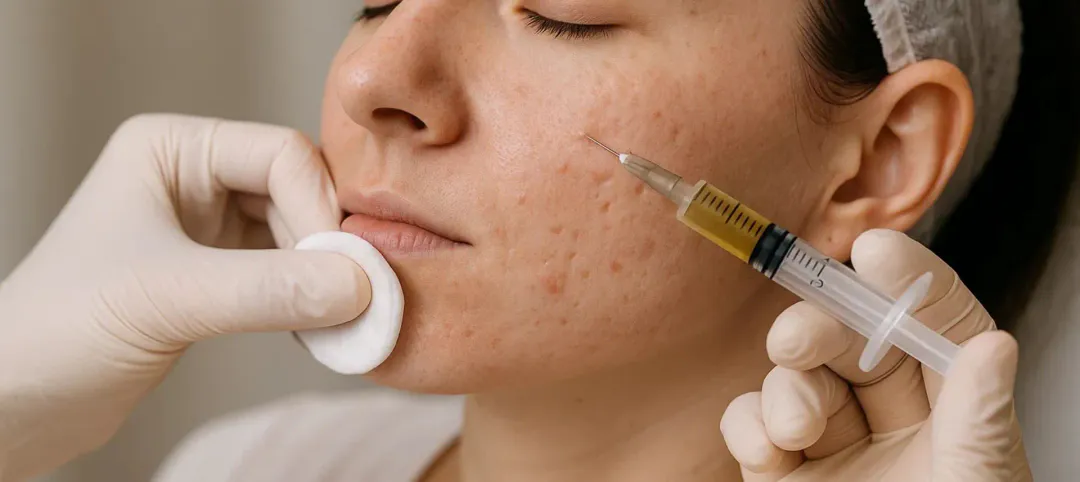
The doctor injects PRP into the base of the atrophic scar after it has been released by subcision. The abundant growth factors and proteins in PRP then stimulate collagen and elastin production and promote cell growth to “fill” the space created by the scar.
PRP can also be applied to the skin surface after microneedling, RF, or laser treatment. These procedures create micro-injuries that act as tiny channels, allowing PRP to penetrate deeper into the skin and support cellular repair as described above. However, topical application is less able to reach the same depth and target the scar base as precisely as injection.
In summary, regardless of the delivery method, PRP helps improve acne scars by stimulating collagen and elastin production to support the scar base and improve skin surface contour. Atrophic scars form when collagen is damaged, causing the skin to become depressed. PRP helps support the repair of this damaged collagen.
Is PRP effective for acne scars?
PRP can help improve the appearance of atrophic scars, reduce post-treatment swelling and redness, and support a shorter treatment course. These effects have been demonstrated in numerous studies over the years. However, the extent of improvement depends on the severity and type of scars, as well as the treatment modalities combined in the protocol. Acne scar treatment generally requires a multimodal approach, so a single treatment method may not produce noticeable improvement.
The number of PRP sessions also varies from person to person. Some patients may need only one session, while others may require additional sessions. These factors should be assessed by a dermatologist before and throughout the treatment process.

Note:
Although PRP can be useful in acne scar treatment, it is not suitable for:
- Individuals at high risk of transmissible infections, such as hepatitis or HIV/AIDS.
- Individuals with hemodynamic instability, platelet function disorders, severe thrombocytopenia, sepsis, or immunodeficiency.
- Individuals with conditions that impair wound healing, such as diabetes, hypertension, or cardiovascular disease, may not be suitable candidates for PRP treatment.
- Individuals receiving anticoagulant therapy.
- Individuals with a skin infection at the treatment site.
- Pregnant women.
The following individuals should be carefully evaluated before treatment:
- Continuous NSAID use within 48 hours before PRP treatment.
- Corticosteroid injection into the treatment area within 1 month before treatment.
- Systemic corticosteroid use within 2 weeks before treatment.
- Smoking.
- Fever or an acute illness around the time of PRP treatment.
- Cancer, particularly hematologic or bone cancer.
- Hemoglobin levels below 110 g/L.
- Platelet count below 150,000/mm³.
Advantages and disadvantages of PRP for acne scars
| Advantages |
|
| Disadvantages & risks |
|
Conclusion
PRP provides various nutrients and proteins and can be an effective treatment for atrophic acne scars, with a low risk of complications when performed by a qualified dermatologist. The PRP centrifugation and extraction process and the kits used at Wedo Skin Clinic comply with Ministry of Health regulations, helping ensure standardized PRP preparation and minimize the risk of infection and cross-contamination.
Follow the Knowledge section for more useful information!
Related questions:
1. Can PRP actually fill in atrophic acne scars?
PRP can help improve atrophic acne scars. It tends to be more effective when combined with treatments that stimulate collagen remodeling, such as microneedling or fractional CO₂ laser, rather than used alone. A systematic review and meta-analysis found that microneedling or subcision combined with PRP improved scar assessment scores more than these treatments without PRP.
2. Should PRP for acne scars be injected or applied topically?
PRP can be delivered to the treatment area in several ways, depending on the treatment protocol, including intradermal injection or topical application after procedures that create micro-injuries, such as laser or microneedling. It should not be assumed that injected PRP is always more effective than topical PRP. Current studies vary considerably in PRP preparation, platelet concentration, delivery method, and combination protocols. This is also one reason why the evidence for PRP remains inconsistent.
3. Should PRP be combined with fractional CO₂ laser for acne scar treatment?
Yes. Some studies and meta-analyses suggest that adding PRP to fractional CO₂ laser may improve treatment outcomes and shorten certain aspects of post-laser recovery compared with laser alone. A meta-analysis of 11 randomized controlled trials involving 313 patients with moderate to severe atrophic acne scars found greater clinical improvement and satisfaction in the CO₂ laser + PRP group than in the CO₂ laser-only group.
However, this does not mean that every case of atrophic acne scars requires PRP + CO₂. The doctor should assess the scar type, severity, and skin condition to determine the appropriate treatment approach.
4. Can PRP replace fractional CO₂ or other acne scar treatments?
PRP should not be considered a complete replacement for other acne scar treatments. A randomized study comparing fractional CO₂ laser, microneedling, and PRP monotherapy found that after four sessions, fractional CO₂ produced greater scar improvement than PRP alone; the study also found that PRP monotherapy did not achieve the desired level of improvement.
This is consistent with AAD guidance: PRP is often used to enhance the effects of another scar treatment rather than being routinely used as a standalone treatment.
5. Is PRP for acne scars safe, and does it require a long recovery period?
PRP is generally considered to have a favorable safety profile, but treatment-site reactions may still occur, particularly when combined with laser or microneedling. Meta-analyses have found that PRP combination treatments may be associated with shorter durations of erythema and crusting than the same protocols without PRP.
However, actual recovery time depends primarily on the accompanying treatment. For example, PRP combined with fractional CO₂ laser will involve recovery associated with the laser treatment, so it should not be described as “no downtime” simply because PRP is used. Before treatment, patients should ask their doctor about the combination treatment, expected duration of redness or peeling, and post-procedure skincare.
Related articles: