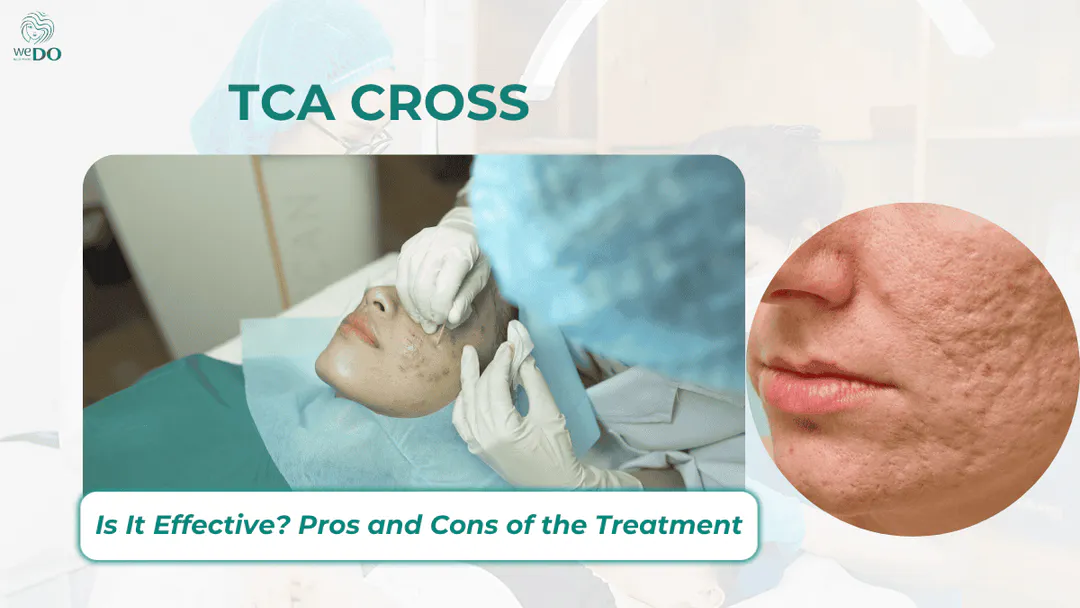
Small, deep acne scars are a common concern for many people—especially when previous treatments have shown limited results. Among various available methods, TCA cross is highly regarded for its ability to target individual scars and stimulate skin regeneration. But how effective is TCA cross really? And is this treatment suitable for all skin types?
Understanding the TCA CROSS Technique
TCA CROSS (Trichloroacetic Acid Chemical Reconstruction of Skin Scars) is a dermatological procedure that uses high-concentration trichloroacetic acid (TCA) applied precisely to each depressed scar. Unlike full-surface treatments such as laser or microneedling, TCA CROSS acts directly on specific scar points, triggering a controlled inflammatory response at the base of the scar.
When TCA penetrates the skin, it causes protein coagulation, altering the structure of the epidermis and dermis layers. This process activates the skin’s natural healing mechanism, promoting the production of new tissue and collagen. Over time, the scar base gradually elevates, leading to smoother and more even-toned skin.

How TCA CROSS Helps Improve Acne Scars
- Controlled exfoliation
Removes hardened, keratinized skin cells around the scar surface, brightening the skin and supporting new cell growth.
- Collagen stimulation
The mild inflammatory reaction after TCA application activates fibroblasts, promoting collagen and elastin synthesis — the key elements that help lift and fill indented scars.
- Smoother skin texture
As new tissue forms, the treated area becomes smoother and more refined, restoring a healthier and more even skin surface.
Because of these effects, TCA CROSS is especially effective for ice-pick scars — small, deep scars that are typically resistant to laser or microneedling treatments.

Is TCA CROSS Effective for Acne Scars?
The effectiveness of TCA CROSS depends on the type and depth of scars treated:
-
Ice-pick scars: The most common type of acne scars, accounting for 60–70% of all atrophic scars. TCA CROSS works exceptionally well for these scars, significantly improving depth and appearance.
-
Small boxcar scars: The treatment can also help lift and smooth these scars with visible improvement over time.
-
Rolling scars: These are shallower and caused by fibrotic tissue beneath the skin. TCA CROSS alone may not be sufficient and usually requires combination with subcision, RF microneedling, or fractional laser for optimal results.
However, treatment outcomes vary depending on factors such as scar type, skin condition, practitioner expertise, and post-procedure care. After treatment, mild peeling occurs within a few days, followed by tissue regeneration. During this recovery phase, strict sun protection, adequate hydration, and gentle skincare are essential to prevent complications such as hyperpigmentation, hypopigmentation, or new scarring.
A thorough evaluation by a qualified dermatologist is crucial to determine the correct approach and ensure safe, effective results.
Pros and Cons of TCA CROSS
Pros
-
Highly effective for deep ice-pick scars
-
Adjustable acid concentration for different skin types and scar depths
-
Short recovery time with simple aftercare
-
More affordable than many high-tech treatments
-
Can be safely combined with other procedures (fractional CO₂ laser, subcision, microneedling, PRP, RF microneedling, etc.) for enhanced results
Cons
-
May cause temporary redness, irritation, or mild burning if applied incorrectly
-
Risk of post-inflammatory hyperpigmentation (PIH) or hypopigmentation, especially in sensitive skin
-
Overlapping application can lead to larger scars
-
Should only be performed by trained dermatologists—not recommended for self-treatment
Who Is TCA CROSS Suitable For?

This treatment is best suited for:
-
Ice-pick scars: The ideal indication, as TCA can reach deep into the scar base and stimulate effective tissue regeneration.
-
Small boxcar scars: Responds well when properly combined with other treatments and post-care.
-
Rolling scars: Less effective when used alone, but beneficial when combined with complementary techniques.
-
Individuals with healthy, non-sensitive skin and no history of post-inflammatory hyperpigmentation.
Conclusion
TCA CROSS is an effective treatment for deep, narrow acne scars, particularly ice-pick types. However, its success depends on accurate scar assessment, precise technique, and proper aftercare. This is not a do-it-yourself treatment — it should only be performed at reputable dermatology clinics under professional supervision.
Related articles:
How Much Does Acne Scar Treatment Cost?
FAQs About TCA CROSS for Acne Scars
1. Why is TCA CROSS considered effective for difficult-to-treat scars?
Because it delivers high-concentration acid directly to the scar base, stimulating collagen production from within. This gradually lifts the scar, especially effective for deep, narrow ice-pick scars that other methods struggle to reach.
2. How long does it take to see results?
Visible improvement can be observed after several weeks to a few months, depending on individual skin response and scar severity. The skin needs time to peel, regenerate, and build new collagen.
3. Can TCA CROSS be used for large scar areas?
It’s best suited for small, scattered scars. Applying TCA over large or closely spaced scars may cause merging and worsen scarring.
4. What aftercare is necessary for best results?
Avoid sun exposure, keep the skin moisturized, and do not pick or scratch the treated area. Proper post-care minimizes pigmentation and supports healing.
5. How is TCA CROSS performed safely at Wedo Skin Clinic?
At Wedo, TCA CROSS is carried out by experienced dermatologists who carefully control concentration and application technique based on scar type and skin condition. This ensures maximum efficacy while minimizing risks.